

With the further promotion of intelligent city and green ecology initiatives, the environmental sanitation management of beaches in coastal urban scenic areas is rapidly moving toward automation and intelligence. Relying on their efficient and refined operation capabilities, beach cleaning robots are gradually replacing the traditional "manual labor + simple trailer" cleaning model and becoming the main force for coastline cleaning.
These robots must operate stably in harsh environments such as high-temperature exposure, salt spray corrosion and wind-sand erosion, while also meeting the refined screening requirements for cigarette butts, microplastics, fine gravel and other debris. Faced with complex outdoor environments and high-standard cleaning demands, how to equip beach cleaning robots with a powerful and reliable "brain"? The APQ TAC-3000 Pro series controller provides the perfect solution with its ultra-compact body and powerful edge computing power.
Customer Pain Points: Challenges from Harsh Outdoor Beach Environments
In the special beach operating scenario, the robot main controller faces severe challenges:
Harsh Environment Adaptability: Coastal air contains heavy salt spray, sand surface temperatures are extremely high in summer, and temperature differences between day and night are significant. In addition, robots operating on soft sand endure continuous high-frequency vibration. The controller must support wide-temperature operation and anti-vibration performance to avoid hardware failures caused by fan dust accumulation and salt spray corrosion.
High-Concurrency Computing Power Demand:The robot needs to simultaneously run 3D vision SLAM navigation, multi-line LiDAR obstacle avoidance, and AI-based recognition algorithms for complex litter such as cigarette butts and microplastics. Traditional low-computing-power controllers can hardly support multi-task concurrency, often resulting in frame lag or recognition delay, which leads to missed cleaning or robot "slippage" and path deviation.
Complex Fusion Interfaces:The robot chassis integrates depth cameras, LiDAR, RTK high-precision positioning, multi-channel motor drivers and other equipment, requiring the main controller to provide rich I/O interfaces and stable communication buses.
APQ Solution: TAC-3000 Pro Ultra-Compact Computing Engine
To address the above pain points, APQ has launched the TAC-3000 Pro series controller as the core main control unit for beach cleaning robots.
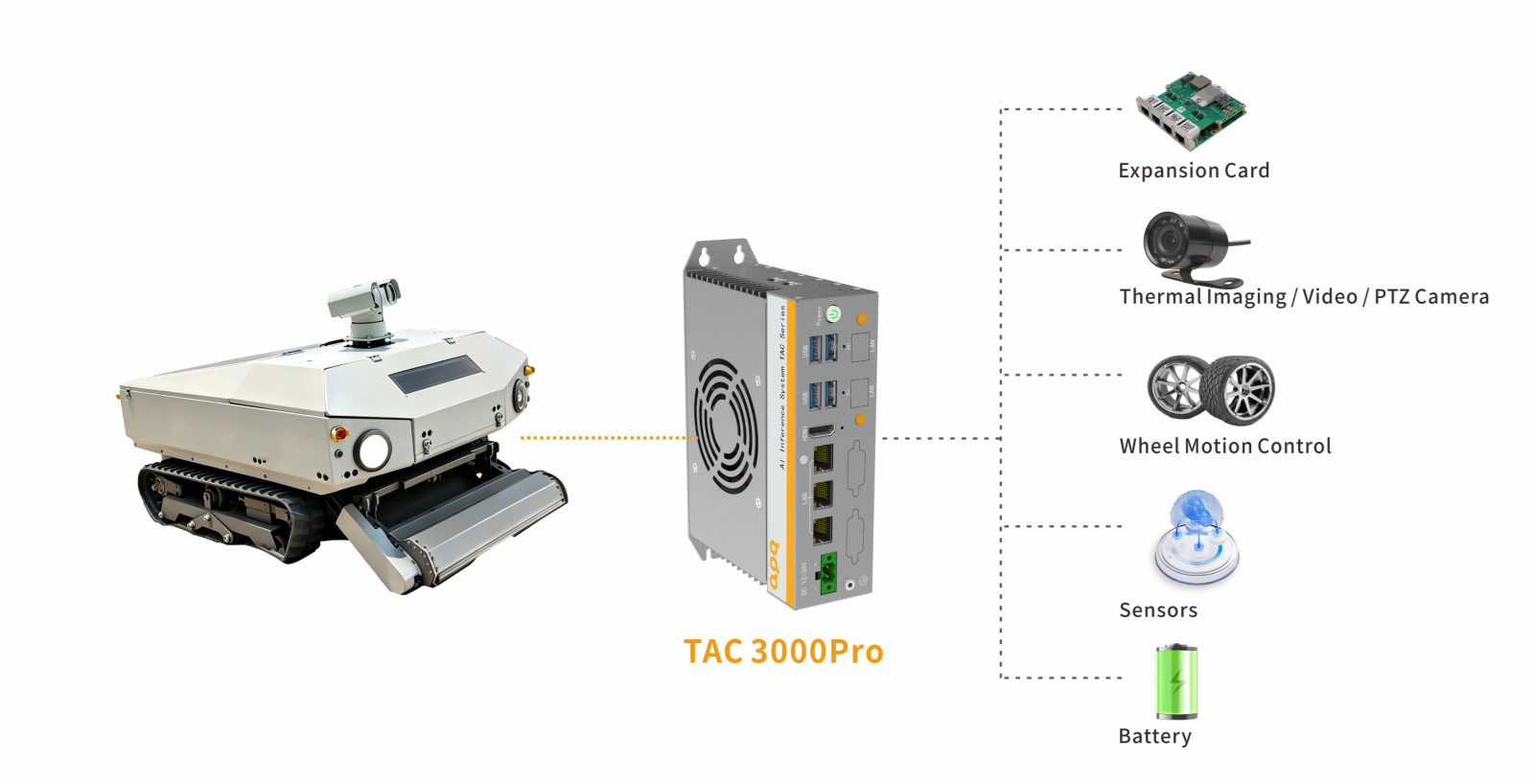
01.Powerful AI Computing Power for Multi-Tasking
Equipped with the NVIDIA® Jetson™ Orin NX 16GB core module, it delivers up to 157 TOPS of tremendous computing power when Super Mode is enabled. This provides sufficient redundancy for the robot to simultaneously process 4K vision obstacle avoidance, AI inference of sand surface litter recognition models, and path planning, ensuring smooth and non-lagging operation.
02.All-Metal Rugged Design with Wide Temperature & Wide Voltage Features
Adopting an all-metal high-strength chassis and active cooling design, it supports a wide operating temperature range of -20℃ to 50℃ and a wide DC 12–28V input voltage, perfectly adapting to large day-night temperature differences on beaches and power fluctuations of vehicle-mounted lithium batteries.
With an ultra-compact size (150.7 × 114.5 × 45mm), it saves valuable space for the compact internal layout of the robot. It supports ear mounting and DIN-rail installation with excellent anti-vibration performance.
03.Rich Industrial-Grade I/O and Expansion Capabilities
Three independent Gigabit Ethernet ports connect to LiDAR, vision cameras and the debugging console respectively, ensuring low-latency transmission of massive point cloud data.
Four configurable RS232/RS485 serial ports provide stable connections to chassis motor drivers and attitude sensors.
Via M.2 and Mini PCIe expansion slots, the robot integrates 5G communication modules and Wi-Fi 6 modules, realizing zero-latency feedback of operation images to the control center and remote operation and maintenance.
Project Outcomes: Stable & Efficient Unmanned Operation Experience
Since the deployment of cleaning robots equipped with the APQ TAC-3000 Pro in trial operation, on-site operation and maintenance performance has improved significantly:
·Doubled Operational Efficiency: A single robot covers far more cleaning area per hour than a manual work crew, enabling 24/7 uninterrupted cruise operations (excluding battery-swapping intervals).
·Centimeter-Level Precision Cleaning: Leveraging the powerful edge computing capabilities of the TAC-3000 Pro, the robot can accurately identify and pick up cigarette butts or gravel as small as a few millimeters in diameter — achieving a level of precision unattainable by traditional mechanical sweeping methods.
·High System Reliability: During several consecutive weeks of testing in coastal environments with high salt spray and sand exposure, the TAC-3000 Pro, with its robust industrial-grade build and stable thermal performance, experienced no downtime or communication interruptions caused by overheating or port corrosion. This has significantly reduced the frequency of shoreline maintenance visits by on-site personnel.
In the wave of intelligent transformation for outdoor special robots, the environmental adaptability and AI computing power of the controller are critical to the success of product deployment. The APQ TAC-3000 Pro series industrial controllers, powered by the Jetson Orin platform’s robust performance, ultra-compact design, and rich industrial-grade interfaces, have successfully solved the three core challenges of beach cleaning robots in complex environments: poor visibility, inaccurate navigation, and insufficient durability.It serves as the ideal edge computing platform for outdoor mobile robots, unmanned sweepers, intelligent inspection equipment, and related applications, empowering partners to develop smarter, more reliable industry solutions.
Post time: Apr-27-2026