
If one moment were to define the robotics industry in 2025, it would undoubtedly be the “backflip” performed on the Spring Festival Gala stage.
Looking back at the start of 2025, most bipedal robots we saw were still taking tentative, unsteady steps under careful remote control,with every move full of hesitation and caution. Yet in just one year, on the Spring Festival Gala stage, robots could leap into the air and amaze the audience with a clean, sharp backflip.
This was more than just a spectacular performance. Within the industry, this backflip is regarded as a significant milestone. It clearly reveals the core trend of embodied intelligence development in 2026: dynamic capability will become a hard metric for evaluating robotic intelligence.
“Ultimate Motion Control – Backflip”: The “Technical Coming-of-Age Ceremony” of Dynamic Capability
A robot’s backflip is far more than a simple replay of pre-programmed movements. It represents the pinnacle of the overall performance of its real-time motion control system, marking a critical watershed for robots from “being able to walk” to “being able to move dynamically” and “being able to withstand impact”. Behind this lie three extreme challenges:
1. Full-body coordination under extreme conditions
A backflip requires all joint motors to burst with massive torque in an instant and achieve millisecond-level precise coordination. From takeoff, aerial rotation to landing cushioning, every stage tests the peak performance of the hardware (motors, drivers) and the ultimate control capability of the motion control algorithm.
2. Real-time adaptation against uncertainties
Unlike smooth walking, a backflip is a dynamic process full of uncertainties. Deviations in takeoff force and disturbances in aerial posture require the robot to complete state estimation and attitude adjustment within milliseconds based on data from onboard sensors (IMU, joint encoders), ensuring a safe landing.
3. Ultimate utilization of the “brain-cerebellum” architecture
“Cerebellum” (real-time motion control core):Responsible for millisecond-level state response and torque control, serving as the “lifeline” that guarantees successful execution and robot safety.
“Brain” (decision-making and planning):Responsible for issuing the “backflip” command and conducting preliminary trajectory planning.Ultimately, the success of the movement depends on the extreme reliability and precise execution of the “cerebellum”.
Role of APQ:Providing the “Neural Center” for “Backflip-Level” Performance
Whether it is Unitree or ZhiYuan, robot companies that have achieved backflips all build their core capabilities on powerful self-developed or deeply integrated motion control systems.On the other hand, APQ focuses on providing the necessary "brain-cerebellum hardware foundation" and "system-level support" for these high-performance robots to achieve "backflip-level" dynamic capabilities
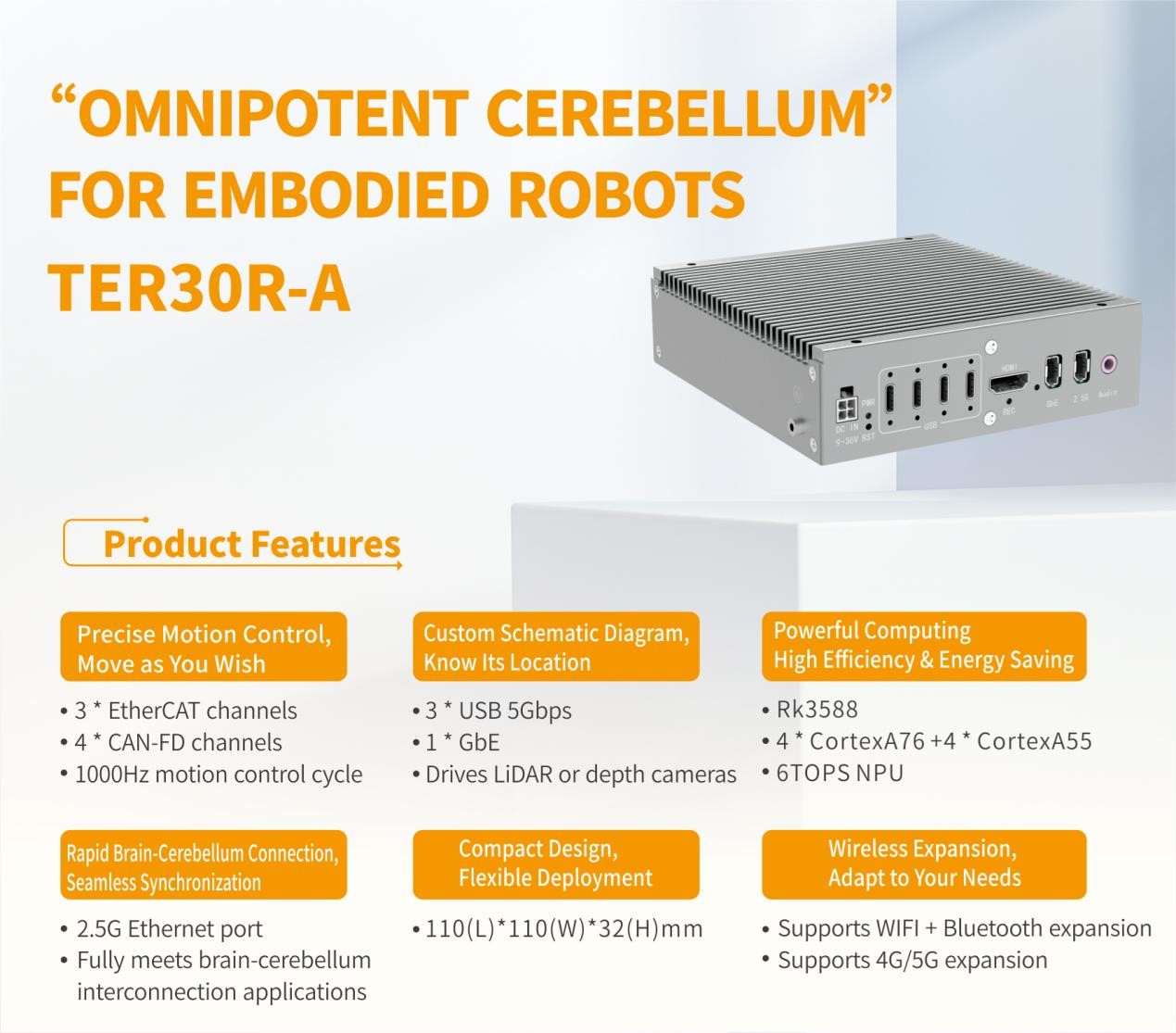
Hardware Carrier for the “Real-Time Lifeline”
APQ’s “Brain & Cerebellum” computing platform is designed specifically to meet extreme real-time requirements. Its “Cerebellum” unit delivers deterministic microsecond-level control cycles and ultra-high-bandwidth internal communication, ensuring that every joint command is executed accurately and on time — the physical foundation for performing high-speed dynamic motions.
Building a Stable and Reliable System Cornerstone
Through deeply customized BSP and real-time operating systems, APQ eliminates “jitter” that could disrupt control cycles, ensuring determinism and low latency across the entire software stack from chip to application. This provides a clean and reliable operating environment for motion control algorithms.
Empowering Developers to Accelerate Innovation
APQ offers open underlying motion control interfaces and mature software adaptation, enabling robot manufacturers to focus on the innovations of core motion algorithms. This accelerates the iteration and deployment of powerful capabilities such as “backflip” performance.
2026: The Leap from “Showy Backflips” to “Practical Capabilities”
Entering 2026, high-dynamic demonstrations represented by "backflips" are transforming from mere technical showmanship into a core endorsement of robots' practical capabilities. It proves that robots have acquired:
Strong impact resistance and self-stabilization capabilities, sufficient to survive in complex and dynamic real-world environments.
A high combination of explosive power and precision, paving the way for undertaking more physical and dexterous tasks in the future.
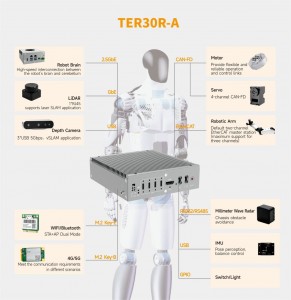
All of this would not be possible without companies like APQ, which focuses on the core “brain and cerebellum” hardware and real-time systems for embodied intelligence. What they provide is the nerves and backbone that enable the robot’s intelligent brain to be deployed safely, rapidly, and precisely.As the industry moves toward higher-level dynamic intelligence, the demand for specialized, high-performance underlying hardware will become increasingly prominent---this is exactly the key role that APQ plays.
Post time: Mar-09-2026