

With the accelerated transformation of the global energy structure, wind power, as a core part of clean energy, keeps expanding in installed capacity. Wind farms are mostly located in remote areas such as high-altitude regions, coastal zones and deserts, featuring scattered stations and harsh operating environments. This puts forward stringent requirements for equipment automatic control, status monitoring and remote operation & maintenance.
Against this backdrop, the ultra-compact and low-power AK1 magazine-style controller from APQ has been successfully applied to wind farm monitoring systems. Featuring compact size, high reliability and rich expandable interfaces, it serves as the on-site lower computer and cooperates with the main control system to complete wind turbine data collection, real-time transmission and equipment linkage control, providing reliable support for intelligent monitoring and operation of wind farms.
Customer Pain Points: Harsh Environment, Limited Space, Difficult O&M

During actual wind farm operation, the customer is confronted with the following challenges:
1.Harsh operating environment & high requirements for equipment stability
Located in high-altitude areas, the wind farm suffers from severe cold in winter (minimum temperature below -20℃), high temperature in summer, as well as continuous vibration and sand erosion all year round. Ordinary commercial devices cannot adapt to such harsh working conditions and fail to maintain long-term stable operation under 7×24-hour unattended scenarios.
2.Scattered sites & high operation and maintenance costs
Wind turbines are widely distributed in scattered locations. Traditional manual inspection features low efficiency and delayed fault response. Failure diagnosis cannot be completed in a timely manner, which restricts power generation efficiency and increases overall O&M expenditure.
3.Complex device interconnection & difficult data collection
Wind turbines are equipped with various sensors for wind speed, wind direction, temperature, vibration and other parameters, together with inverters, PLCs, frequency converters and other equipment. The on-site scenario requires industrial hardware with abundant interfaces and strong scalability to support multi-device access, local data processing and reliable long-distance transmission.
APQ Solution: AK1 Series Magazine-Style Controller
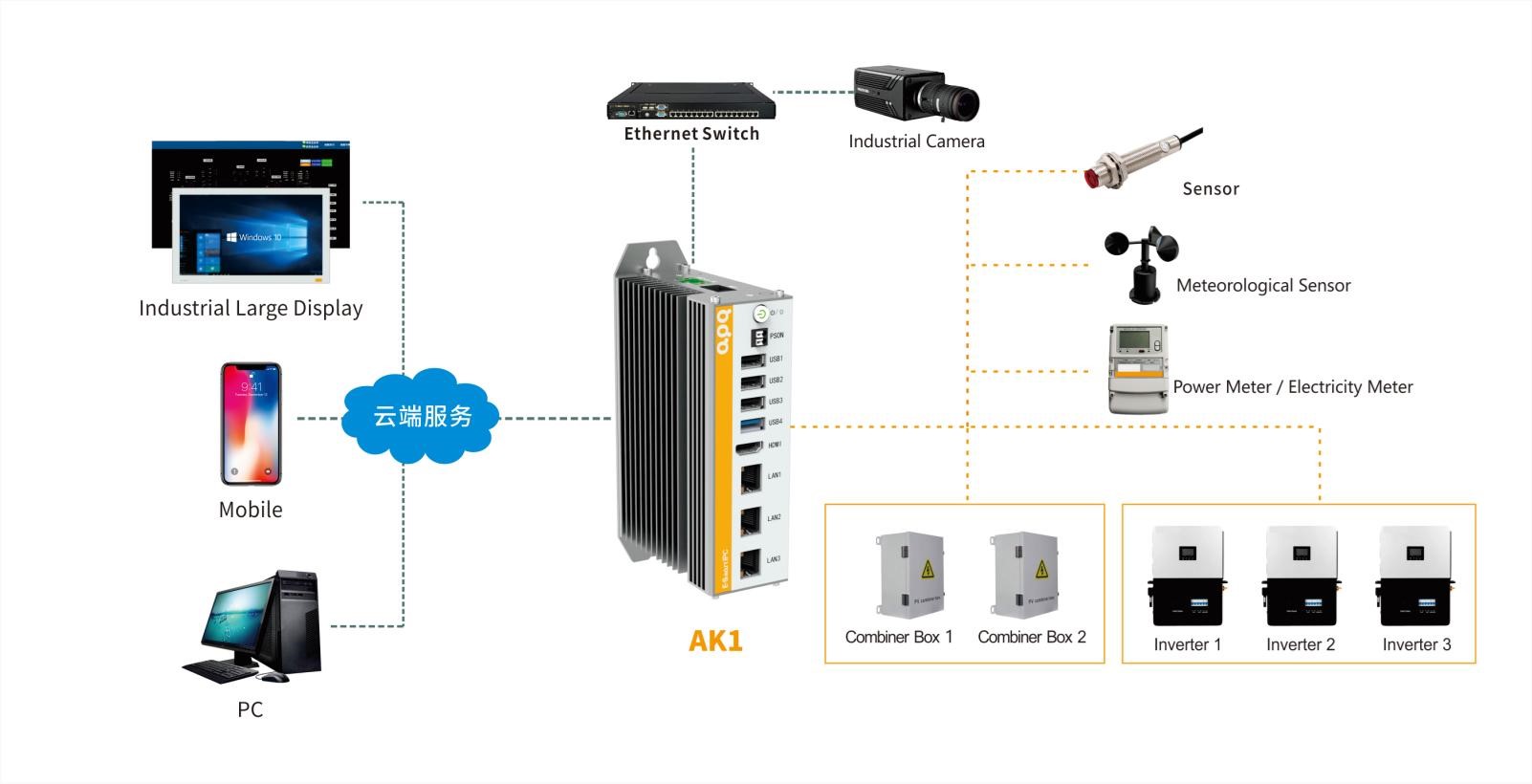
To address the above pain points, APQ delivers an edge node solution based on the ultra-compact AK1 series magazine-style controllers. It serves as an auxiliary lower computer in wind farms, undertaking data receiving and transmission tasks, and operates in coordination with the upper main control system.
1.Ultra-compact form factor for flexible deployment
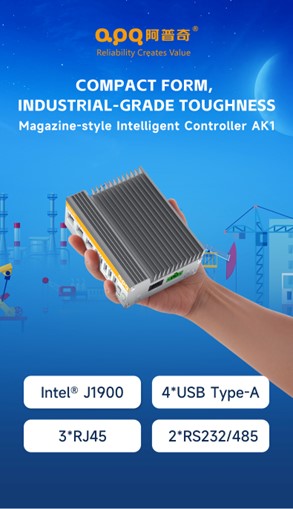
With an ultra-compact dimension of only 139×95.5×43mm, the AK1 series supports wall mounting, DIN-rail mounting and desktop installation. It can be easily deployed in narrow spaces such as control cabinets and grid-connected cabinets at the bottom of wind turbine towers without occupying the layout space of main control equipment.
2.Fanless design for reliable operation in harsh environments
Featuring an all-metal chassis and fanless passive heat dissipation, it delivers robust dustproof and anti-vibration performance. With a wide operating temperature range of -20℃ to 60℃, it fully meets the operational requirements of wind farms in high-altitude environments with extreme temperature variations and continuous vibration.
3.Rich I/O interfaces to support multi-device connectivity
Equipped with 3 Gigabit Ethernet ports, 4 USB interfaces, and 2 RS232/485 serial ports, the AK1 series also supports 1×M.2 Key-M and 1×Mini PCIe expansion. This enables flexible connection to peripheral devices such as wind speed sensors, vibration monitors, inverters, PLC, and frequency converters, supporting data acquisition and transmission.
4.Stable and reliable performance for unattended operation
It supports 12~28V wide-voltage DC input and integrates a hardware watchdog function with power-on auto-start (adjustable AT/ATX mode). The device automatically restarts upon system anomalies, ensuring reliable unattended operation without manual intervention, and works in tandem with the main control system for data reception and transmission.
Project Outcomes: Stable Operation, Improved Efficiency
After deploying the APQ AK1 series as the auxiliary lower computer, the wind farm achieved remarkable results in its monitoring system:
Greatly improved equipment operation stability:
In continuous on-site operation, the AK1 series experienced no unexpected downtime caused by temperature, vibration or dust. It reliably completed data acquisition and transmission tasks, reducing the failure rate of auxiliary links.
Significantly enhanced O&M efficiency:
Leveraging the AK1 series’ multi-port Ethernet and serial expansion capabilities, various small devices inside the turbines (sensors, inverters, PLC, etc.) were successfully connected to the main control system. This enabled local data processing and cloud synchronization, improving the overall scheduling response speed of the wind farm.
Smoother coordination of the monitoring system:
As an edge node, the AK1 series completed preprocessing and stable transmission of data from local sensors and small control devices, eliminating data link bottlenecks and ensuring efficient execution of scheduling commands from the main control system.
The ultra-compact, low-power magazine-style AK1 series controller from APQ demonstrates excellent application value as an auxiliary lower computer in wind farm site monitoring scenarios, thanks to its compact form factor, low power consumption, high reliability and rich interfaces. It is tailored for scenarios such as small auxiliary control devices and simple energy storage cabinets, responsible for connecting inverters, PLC, frequency converters and other equipment, and cooperating with the main control system to complete information reception and transmission. This helps customers overcome O&M challenges posed by harsh environments and scattered sites. Moving forward, APQ will continue to deepen its presence in the new energy industry, delivering efficient and reliable industrial computing solutions for more harsh operating environments.
Post time: Apr-30-2026