
A prominent trend in the past two years is that more and more industrial projects are gravitating towards consumer-grade mini PCs.The reasons are straightforward: they are favored for their compact size, impressive specifications, and budget-friendly pricing—especially those equipped with 12th/13th Gen Intel® processors, which boast highly attractive.
However, if you actually deploy a consumer-grade mini PC within an industrial robot, a production line, or an equipment cabinet for an extended period, you will quickly realize that the real-world industrial site is never an arena for "spec-chasing." Instead, it is a litmus test for stability, reliability, and environmental adaptability.
This is precisely why APQ launched the AK6 Series Industrial Edge PC. We don't build "spec-heavy" machines; we build reliable productivity tools.
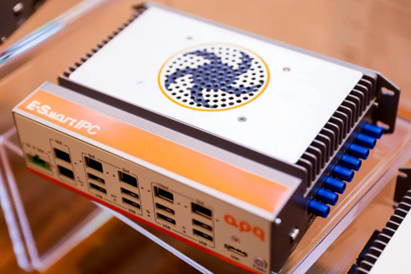
Positioning: Not Just a Mini PC, But an Industrial Edge Computing Core

When first encountering the AK6 series, many people reflexively compare it to consumer mini PCs. Actually, its design philosophy stems from an entirely different starting point.
APQ defines the core positioning of the AK6 as a mid-to-high performance edge PC and control platform tailored for industrial sites. Several key factors distinguish it from a standard "home/office PC":
l Powered by 12th Gen Intel® Core™ i-series processors, ensuring sustained and stable high-performance output.
l Supports dual-channel DDR5 memory (up to 64GB) to guarantee smooth handling of high-concurrency data.
l Fully equipped with essential industrial interfaces, including multiple LAN ports, serial ports (COM), GPIO, and expansion slots.
l Supports 24/7 uninterrupted operation and is engineered to withstand harsh industrial environments.
Compared to consumer-grade mini PCs that prioritize cost-effectiveness and lightweight office tasks, the AK6’s configuration and features are purpose-built for the industrial field. It is designed to provide robust solutions for device interconnection, data acquisition, and real-time monitoring.
Computing Power: Stability is not the only advantage; performance is equally strong.
Many engineers hold a stereotype that Industrial PCs (IPCs) are reliable but lack performance. The APQ AK6 was specifically engineered to shatter this perception
① 12th Gen Core+ Iris Xe Graphics
The AK6 can be equipped with processors such as the Intel 12th Gen Core i5-12450H (65W). Compared to previous industrial platforms, it delivers a significant leap in both single-core and multi-core performance.Its integrated Iris Xe graphics provide practical advantages in visual preprocessing, image inference, and encoding applications. In industrial robotics or vision inspection tasks, it capably handles camera data acquisition, local algorithmic inference (for non-massive models), and multi-tasking scheduling. Its performance clearly outstrips many traditional IPCs.
② The Practical Value of DDR5 for Edge Computing
While DDR5 might seem like a "spec upgrade" in the consumer market, its value in industrial edge computing is far more tangible. It provides ample bandwidth for multi-threaded tasks, ensuring stable throughput for massive cache and image data, and preventing latency spikes during high-concurrency operations. For projects involving machine vision, robot control, or data fusion, this translates into a tangibly superior user experience.
Key Comparison: What Sets It Apart from Consumer-Grade Mini PCs?
This is the primary concern for System Integrators : Is consumer-grade Mini PCs truly inadequate for industrial use?
Based on extensive field experience, our conclusion is clear: consumer mini PCs may be adequate for laboratory environments, testing scenarios, or short-term demonstrations. However, for long-term industrial deployment, they present considerably higher operational risks. The differences are primarily reflected in the following three aspects:
① Stability: Delivering Long-Term Reliability Without Failure
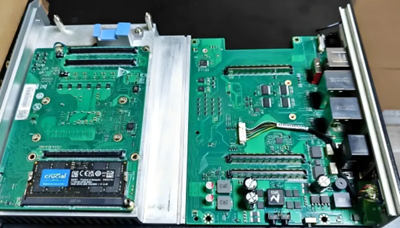
The core issue with consumer-grade mini PCs is not peak performance, but rather their consumer-oriented motherboard design, power delivery architecture, and component selection. These are not engineered for sustained high-load operation, which can lead to system freezes, unexpected reboots, USB or Ethernet port malfunctions, and other instability issues over time.
The AK6 follows an entirely different design philosophy. From the moment it powers on, it is expected to operate continuously and reliably for months or even years. We insist on all-industrial-grade components—from capacitors and chips to interfaces and power modules. We utilize wide-temperature industrial-grade specifications resistant to heat and aging, rather than cost prioritization typical of consumer electronics.
For example, conventional consumer motherboards often use standard electrolytic capacitors, which are prone to capacitance degradation, leakage, and bulging under prolonged high-temperature conditions—ultimately resulting in unstable power supply.In contrast, the AK6 utilizes solid-state capacitors and industrial-grade power management ICs,capable of stable operation in environments ranging from -20°C to 60°C, enduring tens of thousands of hours of uninterrupted work..
To address the pain point of "random reboots," the AK6 incorporates dual-layer protection mechanisms:Built-in overcurrent, overvoltage, and overheating protection circuits that trigger frequency throttling instead of abrupt shutdowns when abnormal parameters are detected;The entire unit utilizes an enclosed, dust-proof cooling structure. By combining copper cooling fins with a fan, it rapidly dissipates core heat, preventing localized overheating and crashes caused by dust accumulation.
② Fan Design: Engineered Specifically for Industrial Environments
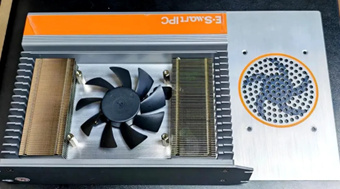
There is a common misconception that "having a fan means a higher failure rate." However, the design goals of an industrial fan are worlds apart from the small turbine fans found in consumer devices. Industrial fans prioritize high airflow, controlled pathways, predictable lifespans, and long-term thermal stability.
The AK6 adopts an industrial-grade active cooling solution because, in scenarios involving high-performance processors, enclosed cabinets, and elevated ambient temperatures, controlled active cooling is safer and more reliable than a completely fanless design.Its innovation lies in a separated external fan architecture. The fan is not mounted directly onto the motherboard. Instead, it utilizes a set of dense, heavy-duty cooling fins for thermal conduction. This design physically isolates the motherboard from external dust and oil while creating a " conduction-dissipation" closed loop to export heat efficiently.The separated architecture also reduces the impact of fan vibration on motherboard components and solder joints, further enhancing stability in high-vibration industrial environments.
③ Interface Configuration: Purpose-Built for Industrial Applications
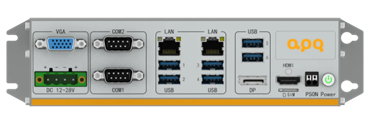
The interfaces on consumer-grade mini PCs are primarily designed for office and entertainment needs, lacking the essential configurations required for industrial environments. They typically omit GPIO, lighting control interfaces, and industrial serial ports. Furthermore, their network ports generally only meet basic connectivity standards, lacking the compatibility and bandwidth isolation necessary for complex industrial networking.
The AK6, by contrast, is purpose-built for industrial environments:
Display Output
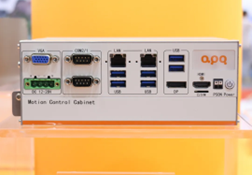
Equipped with DP, HDMI, and VGA ports on both the front and rear panels, the AK6 ensures compatibility with both legacy and modern display devices, supporting multi-screen monitoring and debugging.
Networking and Control
Standard configuration includes dual Gigabit Ethernet ports and dual serial ports, enabling parallel connectivity to industrial cameras, PLCs, switches, and other devices. This facilitates internal/external network isolation or redundant deployment strategies.
Power Supply Design
The system utilizes reinforced Phoenix terminal connectors to prevent accidental power interruption caused by vibration, movement, or complex cable routing environments.
Expansion and Communication
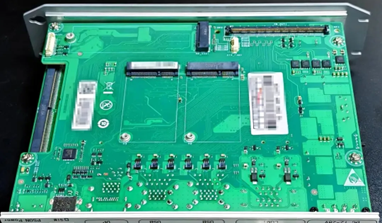
An integrated SIM card slot supports 4G/5G module expansion for deployments without fixed network infrastructure. A remote trigger power-on interface enables centralized control and automatic recovery from abnormal conditions. Additionally, a reserved PCIe expansion slot allows flexible integration of specialized modules such as network interface cards, data acquisition cards, and motion control cards.
This design philosophy—combining interface redundancy with forward-looking expandability—ensures strong engineering adaptability for long-term deployment, going beyond simply stacking parameters.
What Role Does the AK6 Play in Industrial Scenarios?
In practical deployments, the AK6 is rarely treated as a “stand-alone industrial PC.” Instead, it more commonly serves as a core edge computing and control node within industrial sites.Its typical application scenario includes:
① Edge Control Unit for Industrial Robotics
Within robot control cabinets or production line electrical enclosures, the AK6 manages edge-side computing and orchestration tasks. It interfaces with industrial cameras for image acquisition and pre-processing, executes local vision algorithms (such as positioning, identification, and inspection), and provides real-time feedback to PLCs or robot controllers. This localized computing architecture offers fast response times, strong controllability, and independence from external network stability. In applications with strict takt time requirements, the reliability of edge nodes is directly linked to the risk of production line downtime.The AK6 is engineered precisely for such mission-critical environments—where operational failure is simply not an option.
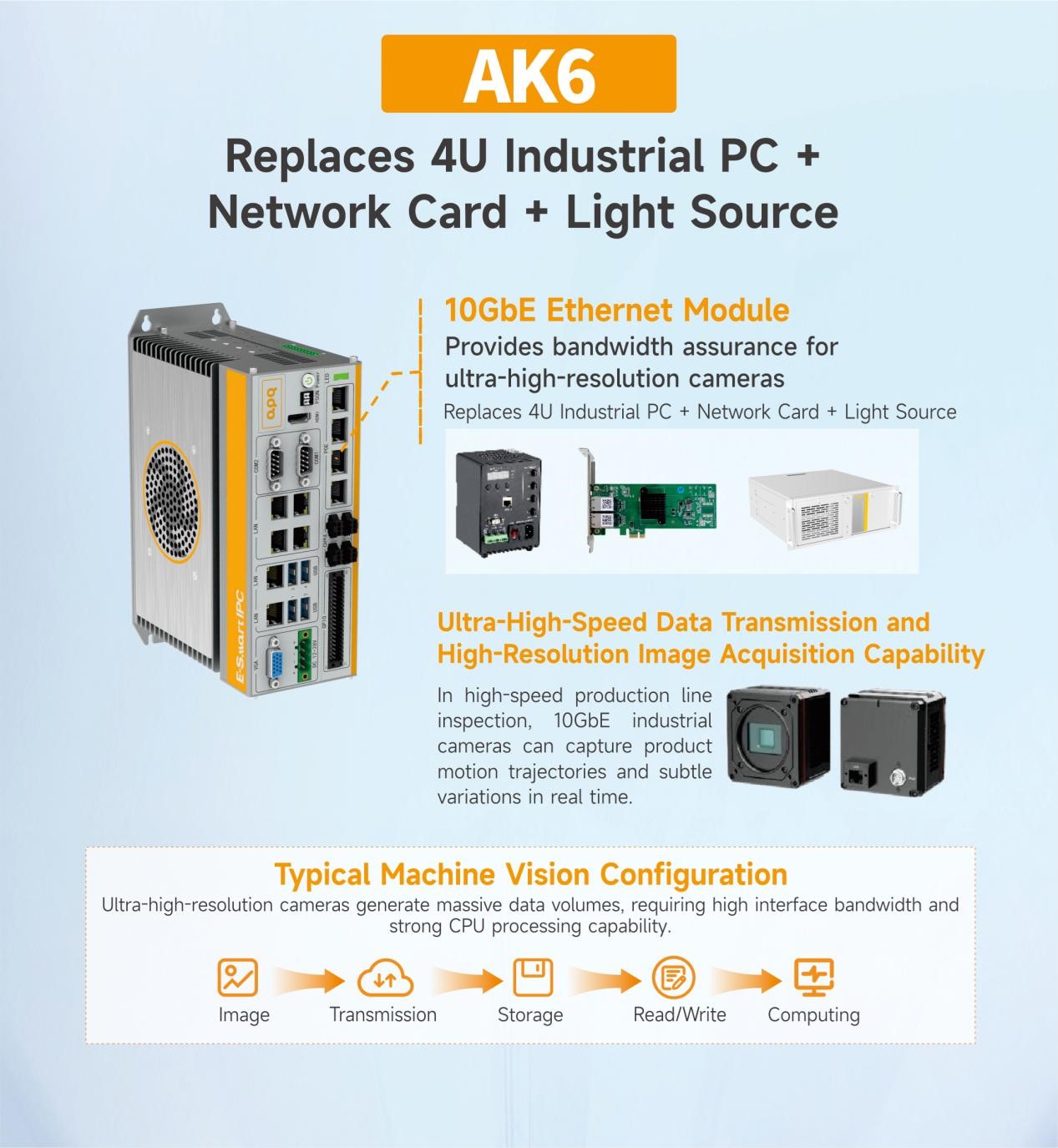
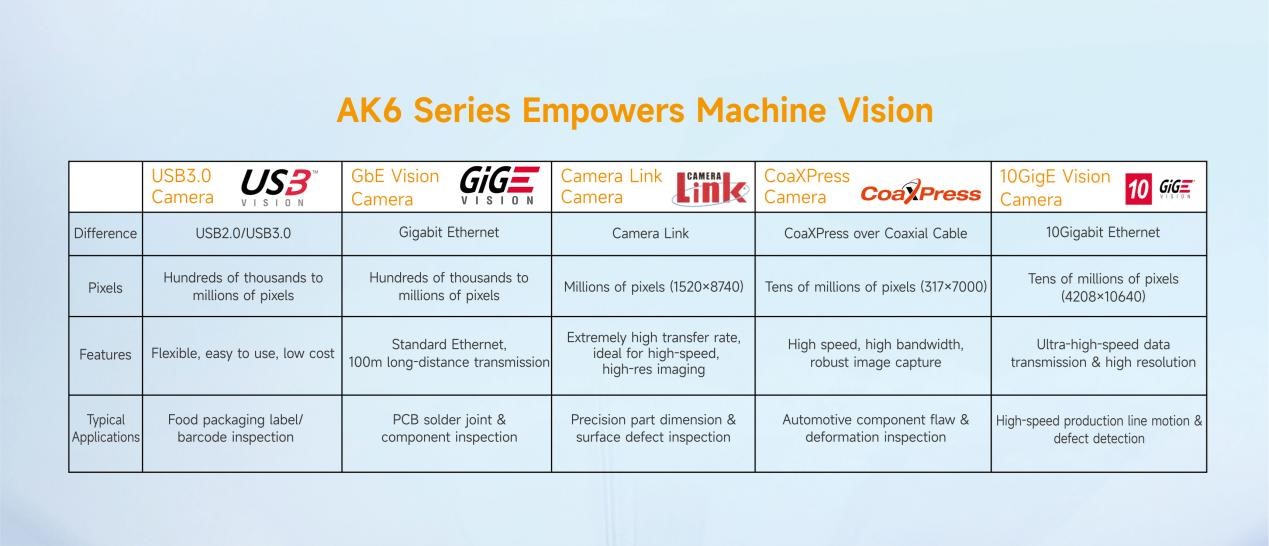
② Dedicated Node for Visual Inspection and Defect Detection
In visual inspection projects, the AK6 serves as a "Dedicated Vision Computing Node." It supports the simultaneous connection of multiple industrial cameras to perform local image inference and analysis, outputting results directly to the host system.Compared to cloud-based processing, local inference offers controlled latency, eliminating the risks of misjudgment or production line stoppage caused by network jitter. In long-duration, high-load, multi-task production environments, the AK6 maintains consistent and stable performance.
③ Edge Data Hub for Smart Production Lines
In production-line-scale projects, the AK6 often functions as a centralized hub for data and control. It handles tasks such as multi-device data aggregation, line status monitoring, local logic execution, and strategic implementation.In this role, it acts more like an "on-site industrial mini-server," built to withstand the challenges of long-term operation, parallel interface usage, and complex multi-task scheduling.These are precisely the scenarios where the gap between industrial-grade platforms and consumer-grade mini PCs is most apparent.
How to Choose: Consumer-Grade Mini PC vs. Industrial Edge Computing Platform
If you are facing the following scenarios, the AK6 Series will be the more reliable choice:
If you are dealing with a truly operational, long-term, unattended industrial project, then choosing a platform like the AK6 series, tailored for industrial environments—is not merely a technical decision, but also a reflection of responsibility for the entire project life-cycle.We firmly believe that in industrial settings, stability is more important than specifications, and reliability is a more worthwhile investment than price.
The AK6 series industrial edge computing host is not just an “industrial PC,” but an edge computing power foundation built for smart factories, robot integration, visual inspection, and other scenarios.Through comprehensive industrial-grade design across hardware architecture, thermal management, and interface configuration, we deliver sustained, stable, and dependable edge computing performance to our customers.
As we often say, “Parameters determine the starting point; reliability determines the finish line.” On the journey toward industrial automation, APQ is willing to walk alongside you.
Post time: Mar-06-2026