

With the in-depth advancement of policies such as the Intelligent Shipping 2030 Action Plan, marine navigation radars are accelerating their evolution from conventional pulse radars to fully solid-state, multi-functional and highly reliable solutions. New solid-state navigation radars must not only enable all-weather long-range target detection, but also integrate multi-source information including nautical charts and AIS to support intelligent collision avoidance and radar health management, placing stringent requirements on the computing power, expandability and harsh-environment adaptability of core control hardware.
To address these requirements, APQ has launched a marine solid-state navigation radar solution based on the onboard computer E7QS-Q170, built on the Intel® 6th-9th Gen desktop processor platform. With the E7QS-Q170 as its computing core, the solution precisely tackles the three key challenges faced by marine navigation radars in harsh marine environments, enabling the development of stable, reliable and flexibly expandable next-generation radar systems.
Difficulty in Long-Term High-Reliability Operation Under Complex Marine Conditions
Customer Challenge
Marine radars are long-term exposed to marine environments with high humidity, salt spray and severe vibration. Ordinary industrial control hardware is prone to corrosion, poor contact, hard disk damage and even system crash. The customer requires the control core to achieve 24/7 uninterrupted stable operation under continuous vibration, wide temperature changes and unstable marine power supply, and to have rapid self-recovery capability.
APQ Solution
Industrial-Grade Reinforced Design: The core circuit undergoes three-proof treatment (moisture-proof, salt-proof and spray-proof), with anti-vibration performance up to 3Grms and anti-shock performance up to 30G, resisting marine environment erosion at the physical level.
Wide-Voltage Isolated Power Supply: Supports 18~36V DC wide-range input, and adopts isolated filtering design to effectively suppress marine power grid fluctuations and surges, ensuring stable system power supply.
Intelligent O&M System: Built-in APQ Cloud Control Hand hardware and IPC Assistant software, cooperating with the IPC Manager remote O&M platform to real-time monitor CPU, memory, hard disk and system processes. In case of abnormal freeze, hard disk failure or system crash, it can self-perceive, automatically restart and actively recover the system.
Value Achievements:
The system operates stably under continuous vibration and wide temperature environments, with a significant reduction in failure probability; relying on the intelligent O&M system to achieve unattended self-recovery, the remote maintenance cost is greatly reduced, effectively ensuring the continuity of radar data during ship navigation.
Bottlenecks in Multi-Sensor Fusion and Complex Expansion
Customer Challenge
The new-generation radar system needs to simultaneously connect multiple sensors and actuators such as GPS, AIS, sound and light alarms, and radar antenna control units, putting forward highly diversified requirements for external bus interfaces, serial port types and quantities. The customer's original controller has a single interface, making it difficult to integrate all functional modules while ensuring signal isolation, which seriously restricts the functional upgrade of the entire machine.
Multi-channel Native Serial Ports: 4*DB9 serial ports, 2 of which support RS232/422/485 full-protocol switching, flexibly adapting to different sensors.
Ultimate Module Expansion: Through the MXM expansion slot, multiple electronic isolated serial ports, independent Ethernet ports or GPIO can be optionally configured to ensure long-distance signal integrity; 4G/5G/WiFi modules can be expanded through PCIe and Mini PCIe slots to realize shore-ship data links.
Multi-display and Storage Expansion: 4-channel display (VGA + DVI-D + DP + internal LVDS/eDP), supporting multi-screen linkage of independent nautical charts and radar interfaces; tool-less quick-replaceable 2.5-inch hard disk bay and M.2 NVMe slot, meeting the local storage needs of massive track data.
Value Achievements
A single controller completes multi-device function integration; multi-channel isolated serial ports ensure stable and interference-free data transmission between the radar and sensors, synchronously improving system integration and reliability, and significantly reducing the overall machine material and costs.
Deployment and Maintenance Challenges in Limited Space
Customer Challenge
The space of cabin control cabinets is limited. Traditional industrial computers are large in size and have a single installation method, making compact deployment difficult. At the same time, once the equipment is installed, subsequent disassembly and maintenance are extremely inconvenient. The customer hopes that the controller is not only compact and small, but also supports flexible installation methods to facilitate daily inspection and quick replacement.
Compact Body: With an overall dimension of only 268×194.2×159.5mm, the structure is highly integrated, which can be easily embedded into various control cabinets.
Multi-attitude Installation: Supports three installation methods (VESA Mount, Wall Mount, Desktop Installation) to meet the space constraints of different ship types and cabins
Independent Heat Dissipation and Tool-less Maintenance: Adopts independent thermal design for CPU and chassis to adapt to the high-temperature environment in closed cabinets; key components such as hard disks and door covers adopt tool-less or quick-disassembly design, reducing on-site maintenance time.
Value Achievements
The controller can be quickly deployed in extremely limited space and easily embedded into the customer's existing radar control cabinets; the downtime during maintenance is reduced, and spare part replacement can be completed within minutes, fully matching the compact and efficient operation rhythm of the ship.
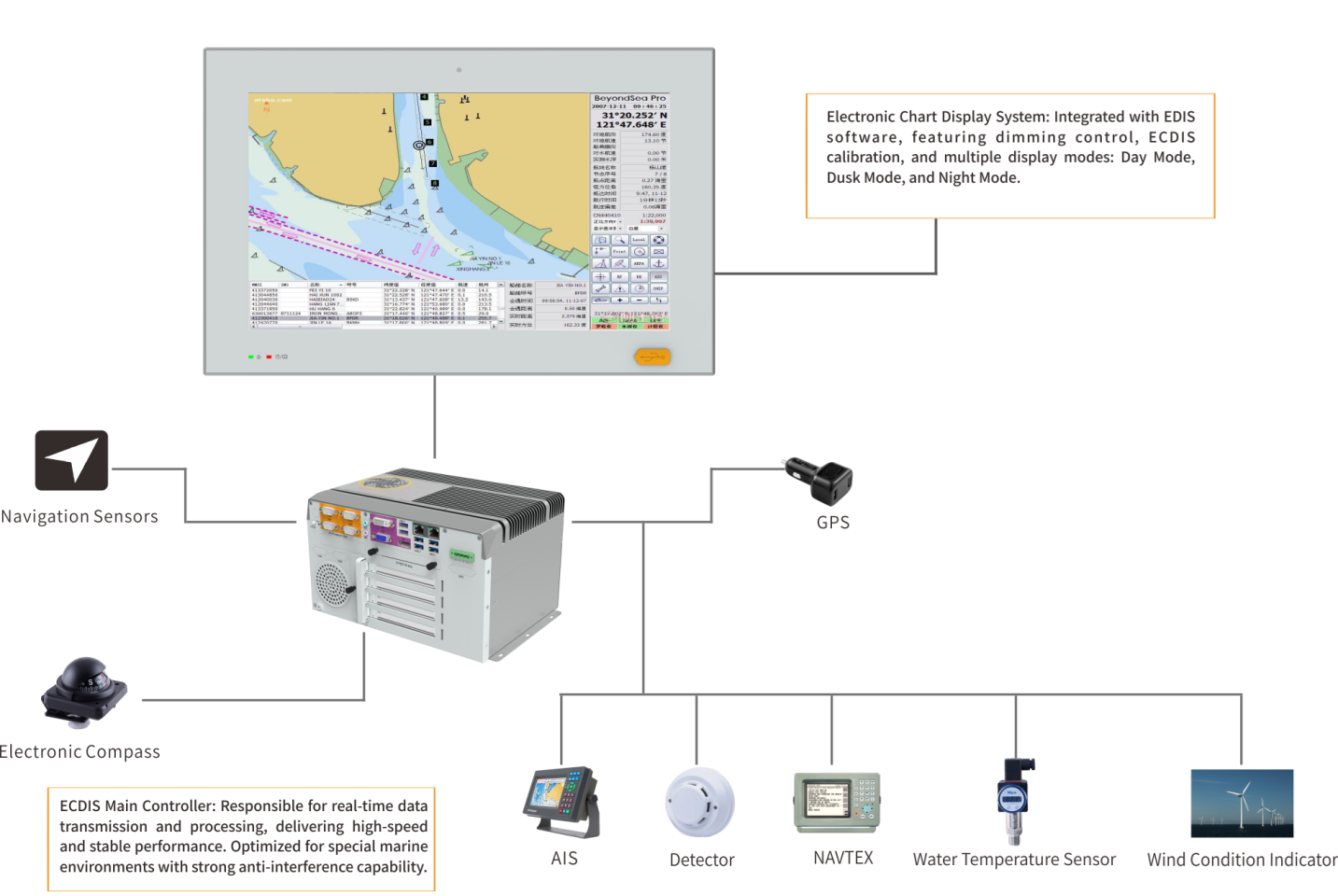
APQ Marine Solid-State Navigation Radar Product Solution
The reliable implementation of the solution relies on the powerful performance support of the onboard computer E7QS-Q170. With its industrial-grade design featuring high expandability, high reliability, and full interface coverage, the product precisely undertakes high-density computing tasks such as marine radar data processing, target tracking, and intelligent collision avoidance.
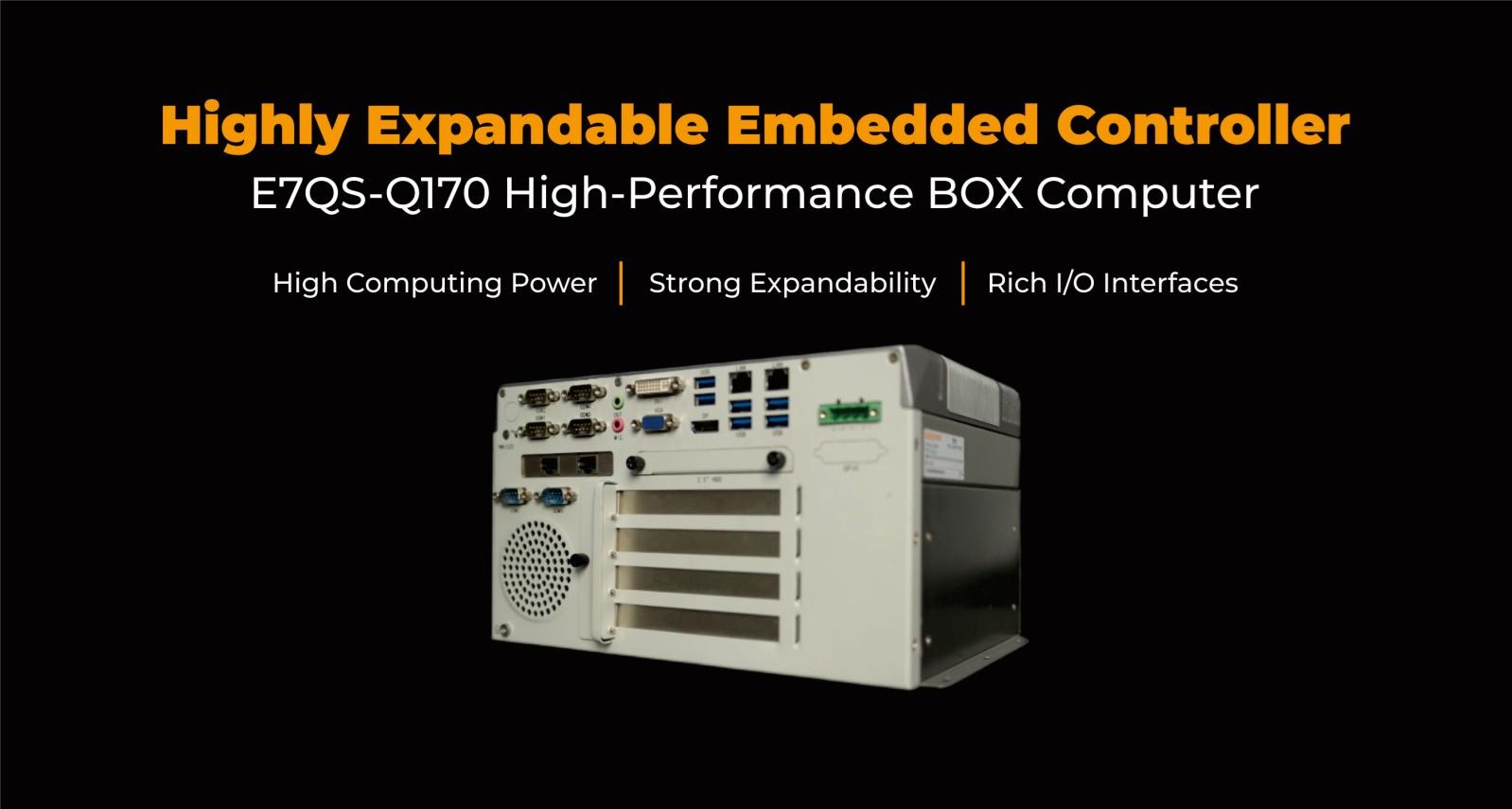
Powered by Intel® 6th-9th Gen Core™ / Pentium® / Celeron® desktop processors and the Q170 chipset, it supports up to 64GB dual-channel DDR4 memory, easily handling multi-frame buffering and real-time analysis of radar echoes.For storage, it adopts a tool-less SATA 3.0 hard disk bay with support for M.2 NVMe expansion.The interface suite includes 2× Gigabit Ethernet ports, 6× USB 3.0 ports, and 4× DB9 serial ports (supporting RS232/422/485). The display output features 4 interfaces, supporting up to 4K@60Hz.The whole unit supports 9~36V wide-voltage power supply, operates in a temperature range of -20~60℃, and has passed vibration/shock resistance and EMC certification. Optional expansion kits including PCIe/PCI, MXM, and aDoor make it an ideal embedded computing core for marine intelligent equipment such as marine radars and electronic chart systems.
With solid embedded hardware expertise, profound expansion design capabilities, and intelligent O&M tools, APQ provides customers with a complete industrial control solution covering real-time data acquisition, multi-sensor fusion, compact and reliable deployment, and remote autonomous O&M.By tackling the three key pain points one by one, we are working together to promote the continuous evolution of marine navigation systems towards full solid-state, high intelligence, and high reliability.
Post time: May-20-2026


