

On May 11, 2026, the Ministry of Industry and Information Technology and four other departments jointly issued the Action Plan for Cultivating Excellent Textile and Apparel Brands (2026-2028). The plan clearly proposes guiding the release of innovative application scenarios for “AI + textiles” across the entire industrial chain, with a focus on promoting advanced technologies such as AI visual inspection and intelligent quality inspection robots, thereby strengthening the quality foundation of brands.The release of this policy has provided strong policy momentum for the textile industry’s transformation from manual visual inspection to intelligent visual inspection.During this critical window for the transformation and upgrading of the textile industry, demand for high-quality fabric inspection equipment is increasing. At the same time, the tension between inspection accuracy and production line efficiency is becoming more prominent, placing higher requirements on the stability and processing capability of industrial computers used for visual inspection.
In quality control for the textile industry, defect inspection on fabric surfaces is a core process for ensuring finished product quality.A domestic integrator of textile fabric production and inspection equipment faced the following challenges when upgrading the core control platform for its next-generation intelligent visual fabric inspection machine:
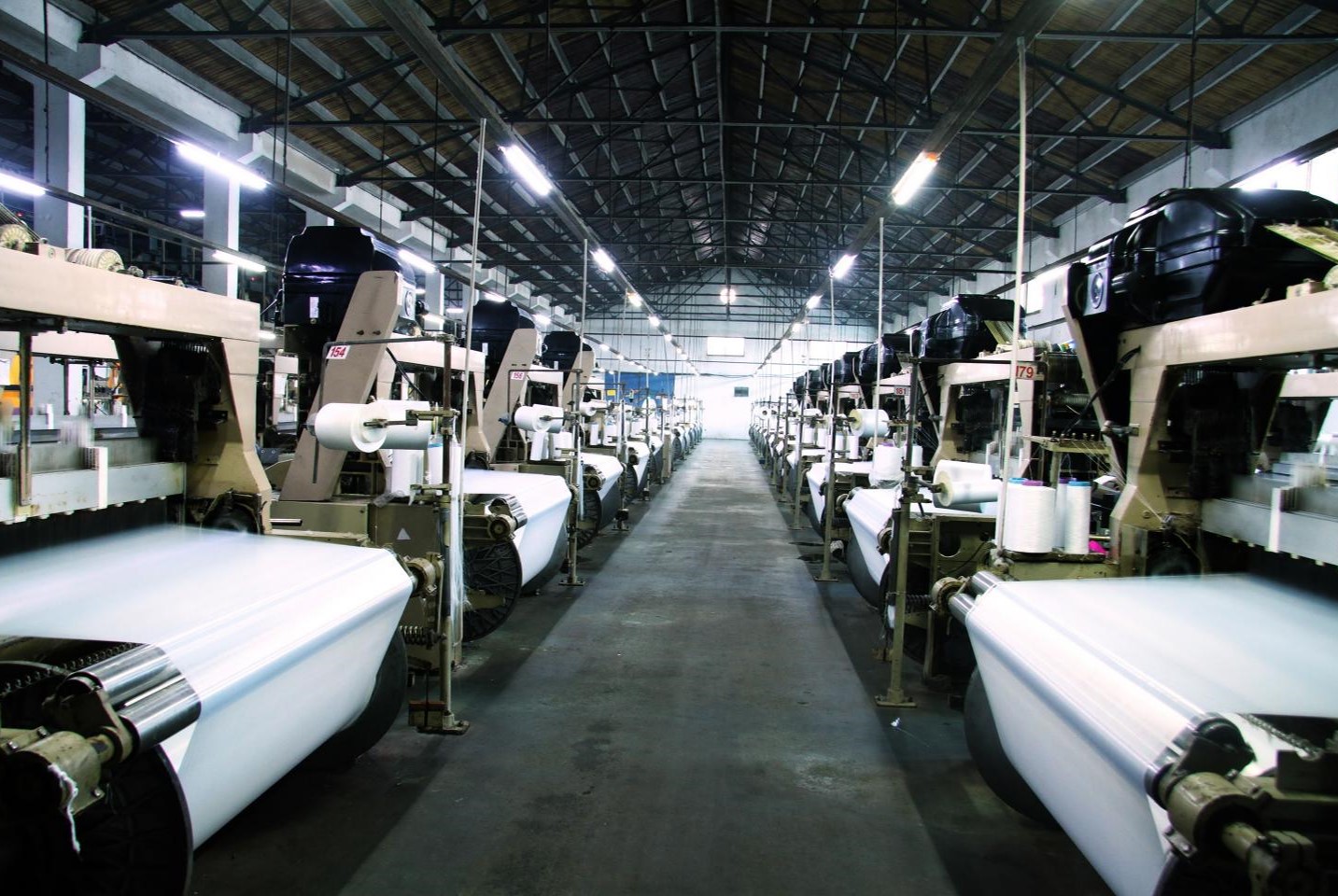
Customer Challenge
1. High-frequency real-time image processing requirements: Fabric surface defect inspection requires real-time acquisition of multiple high-definition camera images on high-speed production lines, placing very high demands on CPU frequency.
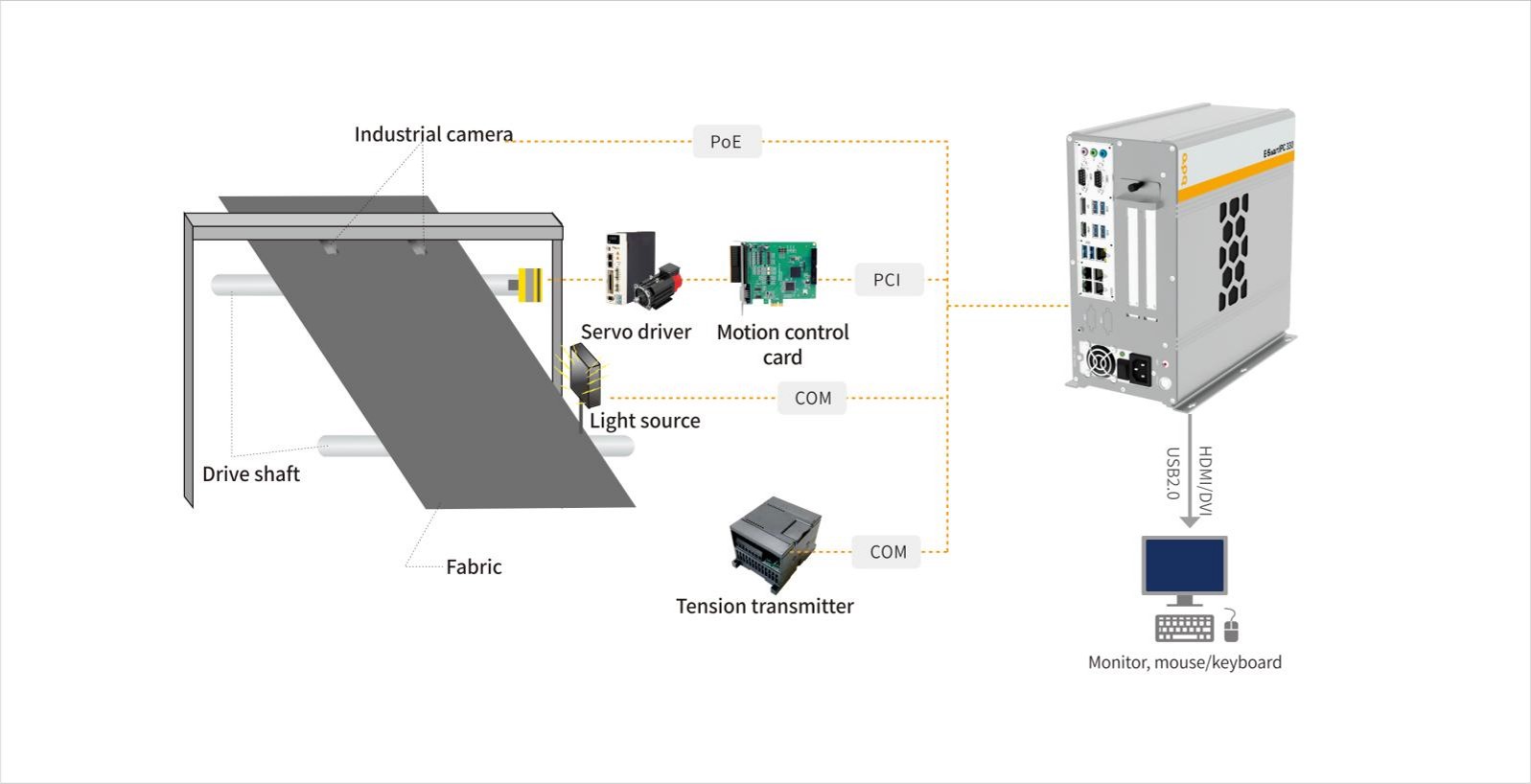
2. Synchronized acquisition from multiple cameras: Textile fabric inspection usually covers the full fabric width. Multiple industrial cameras need to be connected simultaneously on the production line, with synchronized multi-channel image acquisition through Gigabit Ethernet, requiring a high number of network interfaces and stable bandwidth.
3. Rich I/O interface capability: The fabric inspection machine needs to connect simultaneously to peripherals such as laser sensors, encoders, PLC controllers, and light source controllers, requiring the industrial computer to support multiple serial ports and multifunction peripheral integration.
4. Compact space adaptation: The internal structure of the intelligent fabric inspection machine is compact, requiring the core industrial computer to be small in size, efficient in heat dissipation, and flexible for wall-mounted or desktop installation.
5. Adaptability to industrial environments: Textile workshops commonly involve high temperature, heavy dust, and voltage fluctuations, requiring the industrial computer to feature good thermal design, wide-temperature and wide-voltage support, and industrial-grade reliability.
APQ Solution
After multiple rounds of testing and solution comparison, the customer ultimately selected the APQ industrial computer IPC330D-H81 as the core visual inspection platform for its automated intelligent fabric inspection machine. This solution offers the following core advantages:
01 High-frequency processor for real-time image processing:
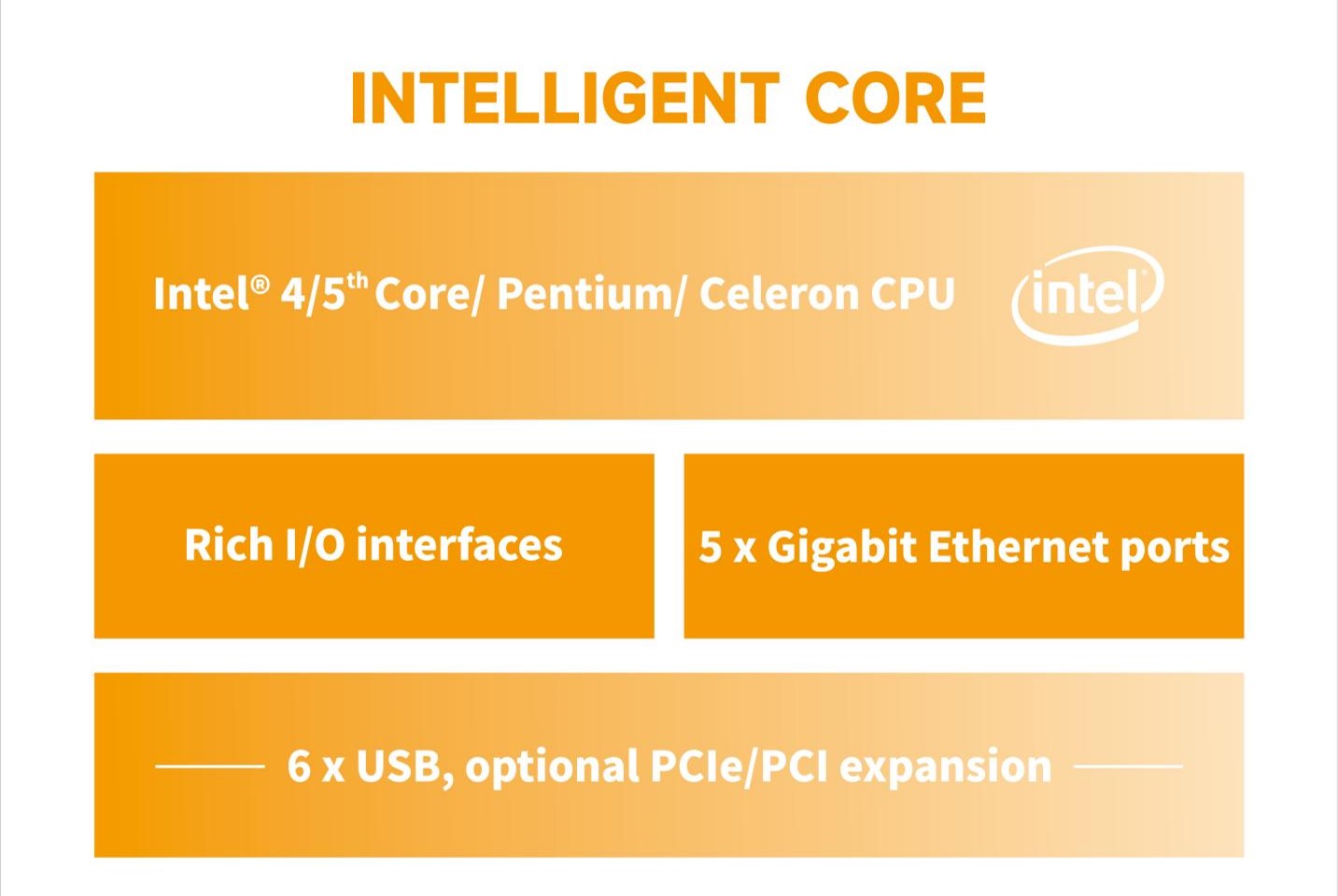
The IPC330D-H81 is equipped with Intel® 4th/5th generation Core/Pentium/Celeron desktop-class CPUs and supports high-frequency processing. Its standard ITX motherboard design meets the real-time image processing requirement of visual inspection applications that demand a CPU frequency of no less than 3.0GHz.With 2 x DDR3 SO-DIMM memory slots, it provides sufficient bandwidth for high-speed acquisition and real-time processing of high-resolution fabric surface images, ensuring that inspection data at dozens of frames per second can complete defect identification in time and meet the takt requirements of weaving or fabric inspection production lines.
02 Five Ethernet ports and six USB ports for comprehensive interface coverage:
5 x RJ45 Gigabit Ethernet ports: Four Intel i210-AT Gigabit Ethernet ports support PoE power supply and can directly power industrial cameras without additional power adapters; one Intel i218-LM Gigabit Ethernet port is used to connect to a backend data center or remote operation and maintenance platform, enabling data separation without congestion.
6 x USB ports: 2 x USB 5Gbps (Type-A) + 4 x USB 2.0 (Type-A), convenient for connecting USB industrial cameras, peripherals, and on-site debugging and maintenance devices.
2 x RS232/422/485 plus 4 x RS232 internal pin headers provide a total of six serial port resources, enabling simultaneous connection to PLC controllers, motion encoders, light source controllers, and other peripherals to build a complete closed-loop control process of image acquisition, computational analysis, and motion linkage.
DP + HDMI dual display interfaces: DP supports up to 3840 x 2160 @ 60Hz, and HDMI supports up to 2560 x 1440 @ 60Hz, meeting the need for real-time visualization of inspection results.
03 Flexible expansion with optional PCIe and PCI:
The IPC330D-H81 provides either one PCIe 2.0 x16 slot or two PCI slots, allowing flexible configuration of high-end image acquisition cards, motion control cards, or light source control modules.At the same time, one Mini PCIe expansion slot supports WiFi/4G wireless expansion, meeting the needs of remote operation and maintenance as well as data backhaul.
04 Compact chassis for flexible deployment in workshop equipment:
With dimensions of only 266 mm x 127 mm x 268 mm, it is more compact than traditional 4U industrial computers. Its low net weight supports both wall-mounted and desktop installation, allowing flexible integration into the limited internal space of an intelligent fabric inspection machine or installation on the side wall of a production line.The all-aluminum alloy molded chassis, combined with PWM intelligent fan cooling, ensures continuous and stable operation in dusty textile workshop environments.
05 Industrial-grade reliability for demanding field environments:
Supports an operating temperature of 0-50°C and wide-temperature storage of -20-75°C, adapting to environmental fluctuations such as high summer temperatures and low winter temperatures in textile workshops.Built-in 8-channel GPIO pin header (4 digital inputs + 4 digital outputs) facilitates expansion for alarm output, shutdown control, and other execution interfaces.Supports an AMI UEFI BIOS watchdog timer (programmable from 1 to 255 seconds), enabling automatic reset during system abnormalities and ensuring 24/7 continuous operation of unattended production lines.Comes standard with one 2.5-inch 7mm shock- and impact-resistant drive bay, using an anti-vibration design to meet data storage reliability requirements in production line vibration environments.
Value Achievements:
By introducing the APQ IPC330D-H81 wall-mounted visual inspection industrial computer, the textile fabric inspection equipment manufacturer successfully achieved the following:
Significantly improved inspection accuracy: With a high-frequency Intel® 4th/5th generation desktop-class CPU, multiple PoE industrial cameras, and Gigabit Ethernet data acquisition capability, the intelligent fabric inspection machine greatly improves defect recognition accuracy. It can quickly detect broken yarn, color differences, stains, holes, and other defect types, effectively addressing the industry pain points of low accuracy and high missed-detection rates in traditional manual fabric inspection.
Reduced system integration complexity: Five RJ45 Gigabit Ethernet ports and six USB ports enable one-machine access for multiple industrial cameras, light source controllers, PLCs, and maintenance platforms. A complete AOI inspection closed loop can be built without additional expansion cards, significantly simplifying the system architecture and reducing overall BOM cost and integration complexity.
Strong production line adaptability: The compact 4U chassis supports wall-mounted installation and can be flexibly embedded into the limited internal space of a fabric inspection machine, freeing more layout space for other functional modules while maintaining stable operation under dusty conditions and voltage fluctuations in textile workshops.
Compatibility with existing hardware assets: The optional PCI expansion slot solution allows customers to continue using their existing PCI motion control cards during system upgrades, ensuring a smooth transition while effectively reducing upgrade costs.
With the policy momentum from the Ministry of Industry and Information Technology and other departments promoting “AI + textiles” applications across the full industrial chain, quality control in the textile industry is undergoing a profound transformation from human visual recognition to machine vision.The APQ IPC330D-H81 wall-mounted visual inspection industrial computer, with its high-frequency desktop-class CPU, rich I/O resources including five Ethernet ports and six USB ports, flexible PCIe/PCI dual expansion options, and compact small 4U chassis design, is well suited to the demanding requirements of automatic optical inspection for fabric surfaces, including high computing power, multiple interfaces, high reliability, and compact installation space.
Post time: Jun-17-2026


