Application Case Study: APQ TER30R-A2 for a Quadruped Robot
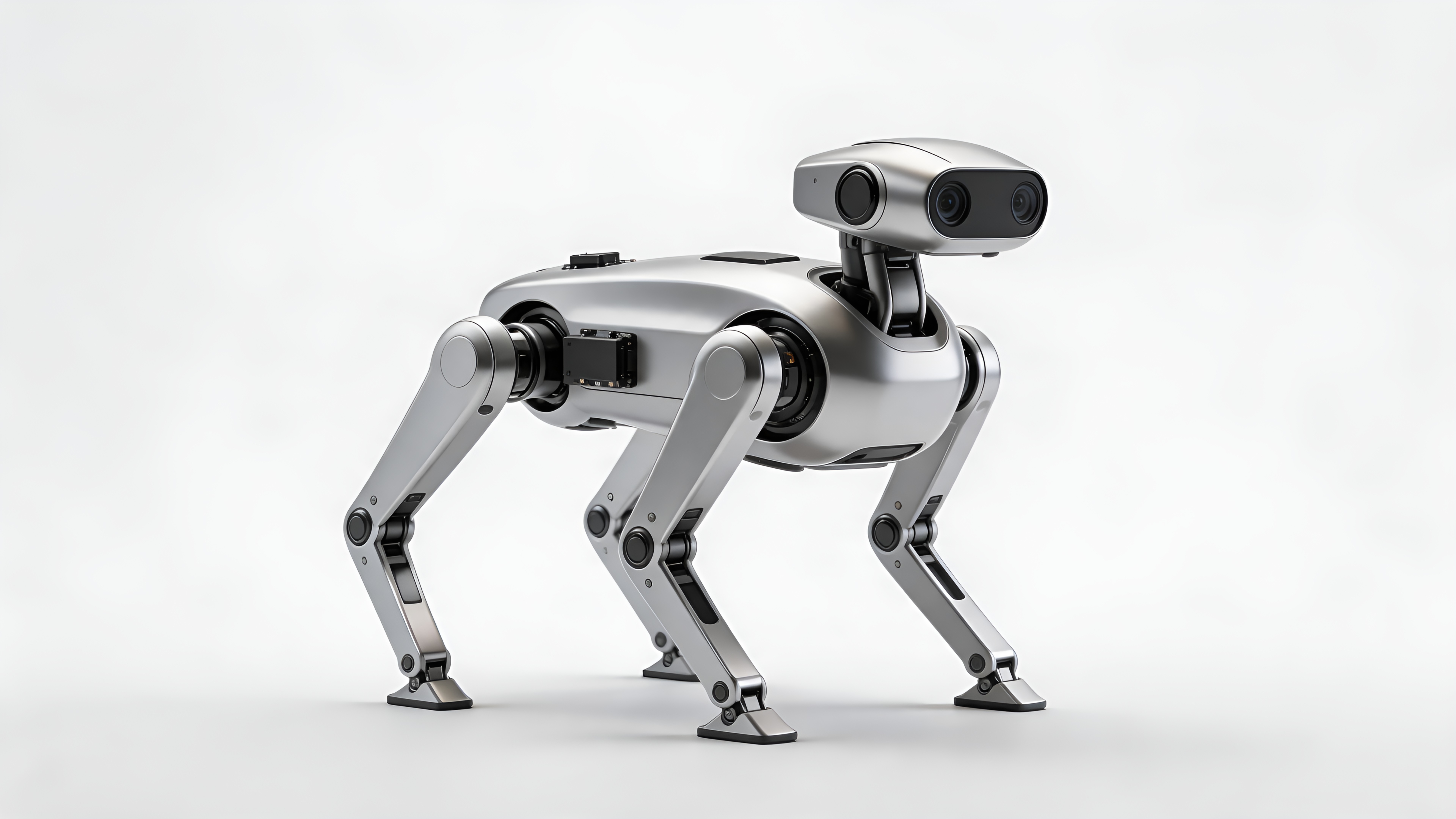
With biomimetic locomotion and strong adaptability to complex terrain, quadruped robots are being rapidly adopted for power inspection, public-security patrols, firefighting and rescue, and industrial-park surveillance. In real-world deployments, however, their motion-control systems face multiple challenges. The controller must remain stable under high-frequency vibration and abrupt posture changes, synchronize more than 12 joint motors with high precision, and fit high-performance computing into a highly constrained body cavity where every millimeter of space matters.
After multiple rounds of product evaluation and rigorous field testing, the customer selected the APQ TER30R-A2 embodied-intelligence motion-control “cerebellum” controller as the core motion-control unit for its next-generation quadruped robot.
Customer Challenge
Hard Real-Time Motion-Control Requirements: Running, jumping, and turning impose strict control-cycle requirements. At a 1,000 Hz control frequency, system jitter must remain below 20 μs to ensure precise and smooth synchronization across multiple joints.
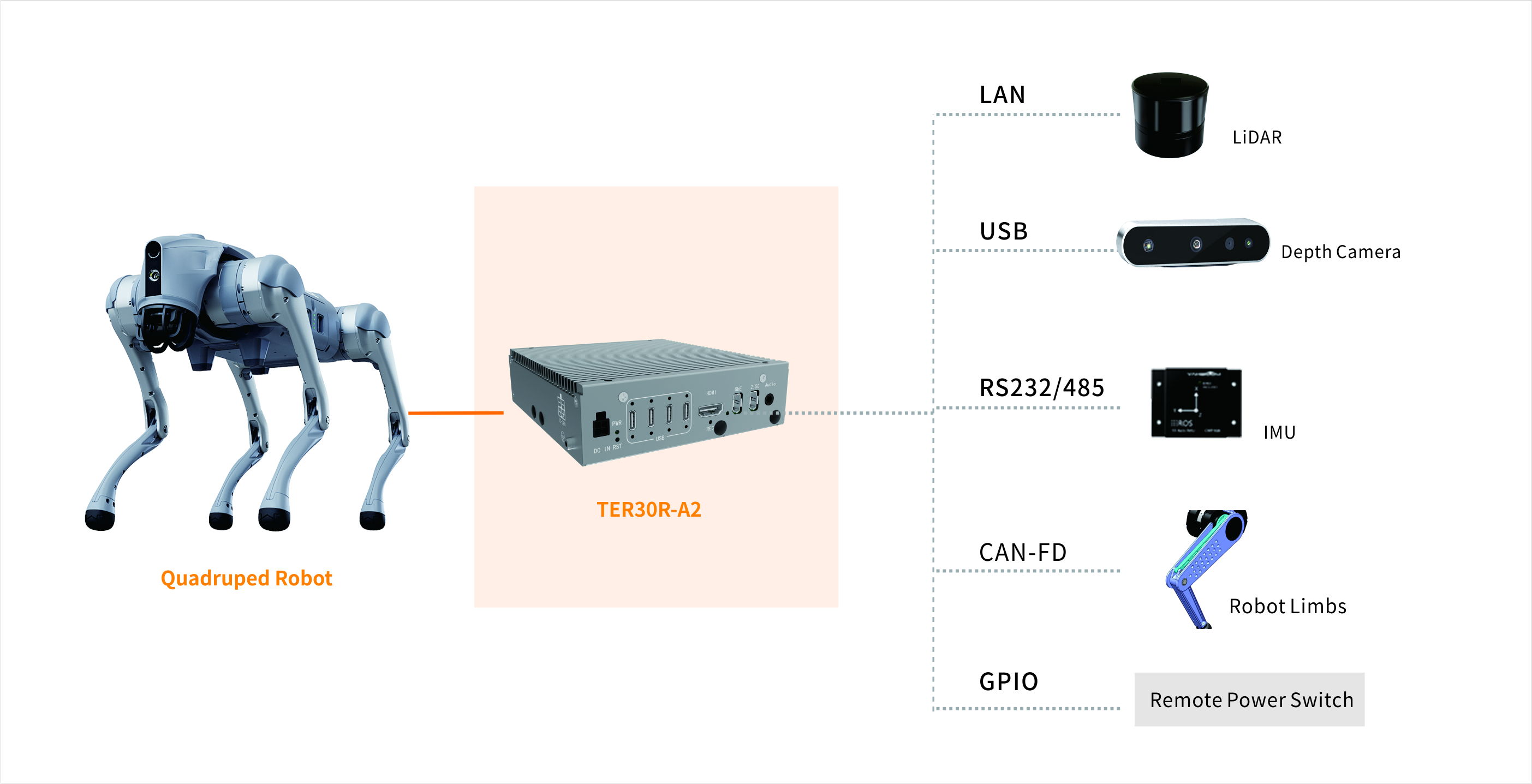
Multi-Interface Device Integration: The system must simultaneously connect LiDAR, depth cameras, an IMU, more than 12 joint motors, and multiple sensors, requiring a controller with extensive industrial I/O resources.
Ultra-Compact Space Constraints: Space inside the robot torso and joint compartments is extremely limited. The controller must deliver the required performance in an ultra-thin, compact form factor, leaving more room for batteries, sensors, and other functional modules.
Rugged Vibration and Shock Resistance: During running, jumping, and obstacle traversal, the robot is continuously exposed to severe vibration and shock. A board-level integrated design is therefore required to prevent connectors from loosening under vibration.
Lightweight Edge AI Computing: The controller also requires edge AI inference capability to run lightweight algorithms for terrain recognition, dynamic obstacle avoidance, and similar intelligent functions.
APQ Solution
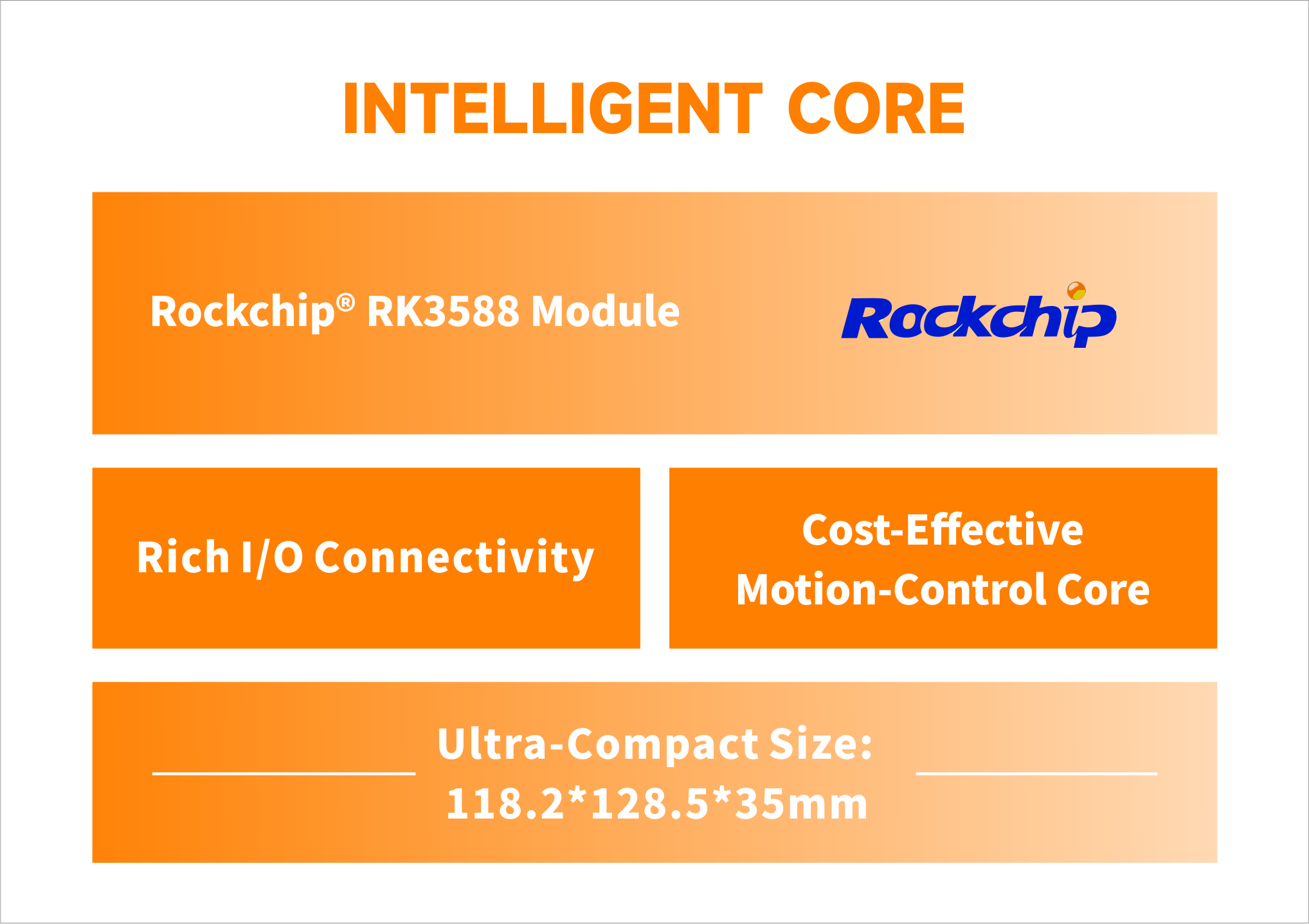
Precision Motion Control with 36-Axis Synchronization:The TER30R-A2 is powered by a Rockchip RK3588 octa-core 64-bit processor with an integrated 6 TOPS NPU. It supports synchronized control of up to 36 axes. At a 1,000 Hz control frequency, system jitter remains below 20 μs. Whether coordinating multiple joints during running, executing rapid turns, or traversing complex terrain, the controller delivers precise and smooth motion control, providing a stable and reliable foundation for dynamic quadruped robot operations.
Rich I/O for Multi-Device Integration:The TER30R-A2 features a purpose-built I/O architecture for quadruped robot systems, consolidating joint drives, perception devices, industrial networks, and actuator interfaces in a single controller. · 4 × CAN FD ports: Direct connection to more than 12 joint motors and their drive systems for high-precision multi-axis synchronized control. · 3 × Gigabit Ethernet ports: EtherCAT support for deterministic, real-time industrial Ethernet communication. · 1 × 2.5GbE port + 1 × GbE port: The 2.5GbE port provides high-speed interconnection with the perception controller, while the GbE port supports LiDAR point-cloud data input. · 8 × USB interfaces (3 × USB 5Gbps Type-C, 1 × USB 2.0 Type-C, and 4 × internal USB 2.0 headers): Support simultaneous connection of LiDAR, depth cameras, commissioning tools, and other peripherals. · 4 × switchable RS-232/RS-485 serial ports: Reliable connectivity for IMUs, ultrasonic sensors, and other peripherals. · 8 × GPIO + 2 × PWM channels: Flexible expansion for lighting control, alarm outputs, and other actuator interfaces. · 1 × HDMI output + 1 × audio interface: Convenient for local commissioning and status visualization.
Ultra-Compact Design for Flexible Integration:Measuring only 118.2 mm × 128.5 mm × 35 mm, the controller is exceptionally compact, with a thickness roughly equal to the diameter of a coin. Its full-aluminum enclosure supports bracket mounting and can be integrated easily into the robot torso or joint compartments, preserving valuable space for batteries, sensors, and other modules. The onboard integrated storage and memory design eliminates connector-loosening risks caused by vibration, ensuring stable operation during dynamic running and complex-terrain missions.
Wireless Expansion for Diverse Deployments:The controller provides an M.2 Key-B slot (USB 5Gbps, 3042/3052 form factors, with a Nano-SIM slot) for 4G/5G modules, as well as an M.2 Key-E slot (PCIe 2.0 ×1 + USB 2.0) for Wi-Fi/Bluetooth modules. Whether deployed at remote substations or for urban industrial-park patrols, it enables real-time connectivity to cloud platforms and command centers.
Industrial-Grade Reliability for High-Intensity Dynamic Operations:The TER30R-A2 is engineered for mobile robot environments with high vibration and shock, while providing wide-temperature operation, wide-voltage power input, and convenient on-site maintenance. · Operating temperature: -10°C to 50°C; storage temperature: -40°C to 80°C. · Validated through 3G random vibration and 30G shock testing for reliable operation during running, jumping, and obstacle traversal. · 12-28 VDC wide-range input supports robot battery systems with different voltage ratings. · The front panel integrates a power switch, system-recovery button, system-reset button, and status indicators for efficient on-site commissioning and maintenance.
Value Achievements:
Precise and smooth motion control: A 1,000 Hz control loop with system jitter below 20 μs enables synchronized 36-axis control, accurately driving joint motors for natural running, jumping, and turning while maintaining stable posture over complex terrain.
All-in-one multi-device integration: 4 × CAN FD, 3 × EtherCAT-capable Ethernet, 8 × USB, and 4 × serial ports enable direct integration of joint motors, LiDAR, depth cameras, IMUs, and other devices without additional expansion modules, significantly simplifying the system architecture.
Compact deployment frees valuable space: The ultra-compact 118.2 mm × 128.5 mm × 35 mm form factor fits easily inside the robot torso, leaving more room for batteries, sensors, and other functional modules.
Stable and reliable under high-intensity motion: The board-level integrated design minimizes vibration-related connection risks, while 3G vibration and 30G shock validation ensures dependable operation during running, jumping, and obstacle traversal.
Lightweight edge AI computing: The integrated 6 TOPS NPU supports lightweight edge AI inference for terrain recognition, dynamic obstacle avoidance, and similar functions, providing the computing foundation for quadruped robots to evolve from autonomous locomotion to autonomous decision-making.