Solution

APQ AK5 Low-Power Multi-LAN Cartridge-Style Controller for Desktop Collaborative Robots

APQ AK5 Low-Power Multi-LAN Cartridge-Style Controller for Desktop Collaborative Robots

APQ AK5 Low-Power Multi-LAN Cartridge-Style Controller for Desktop Collaborative Robots

Desktop collaborative robots are rapidly penetrating applications such as precision assembly in 3C electronics, automated research laboratories, education and training, and medical assistance, thanks to their lightweight design, high precision, and safe human-robot collaboration. Unlike large industrial robots, desktop collaborative robots impose highly specific requirements on controller size, power consumption, interface availability, and expansion flexibility. The controller must be compact enough to fit inside a space-constrained robot body while also providing rich communications interfaces—such as multiple LAN and serial ports—to connect peripherals including vision systems, force sensors, and grippers. It must also support flexible expansion of I/O, lighting control, CAN bus, and other customized functions for different applications.

After multiple rounds of model selection and rigorous field validation, the customer selected the APQ AK5 Low-Power Multi-LAN Cartridge-Style Controller Series as the core control platform for its next-generation desktop collaborative robot.

Customer Challenge

  • Ultra-compact space constraints: The desktop collaborative robot has limited internal volume and extremely restricted installation space, requiring a controller with an ultra-compact form factor that can fit into the robot base or joint housing.
  • Multi-device communication requirements: The robot must communicate simultaneously with servo drives, end effectors, vision systems, force sensors, and other devices. The controller therefore needs multiple independent Ethernet interfaces and abundant serial communication resources.
  • Low power consumption and fanless design: Desktop equipment has limited thermal-management capacity, so the controller must consume very little power and use fanless passive cooling to eliminate fan-related failures and dust ingestion.
  • Flexible expansion capability: Different desktop collaborative robot models have varying I/O and communication-protocol requirements. The controller must support modular expansion so that functions can be configured as needed without replacing the entire system.
  • Industrial environment adaptability: Manufacturing workshops commonly involve temperature fluctuations and equipment vibration, requiring the controller to provide industrial-grade reliability, including wide-temperature operation and vibration/shock resistance.
摄图网_603040004_工业机器人焊接作业火花四溅(企业商用)

APQ Solution

AK5特点(3)
  • Ultra-Compact Chassis for Easy Integration into Desktop Equipment:The AK5 series measures only 53 × 145 × 186.4 mm. It combines an all-aluminum heat sink with galvanized steel top and bottom covers and supports three mounting methods: wall mounting, DIN-rail mounting, and desktop installation. Its ultra-compact chassis can be easily integrated into the robot base or arm, freeing more installation space for other core components such as end effectors and sensors.
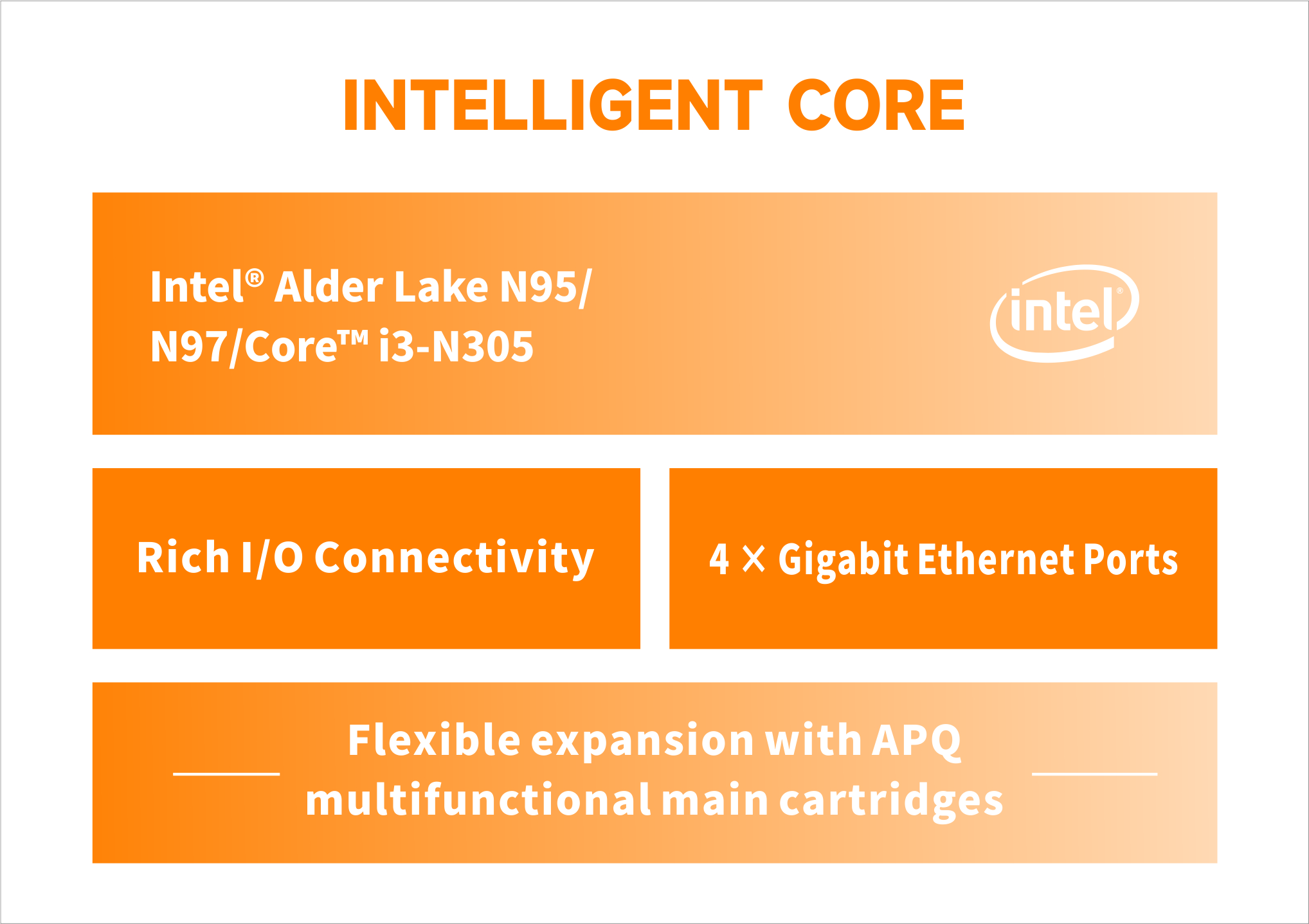
  • Four Gigabit Ethernet Ports for Efficient Multi-Device Communication:Desktop collaborative robots need to maintain real-time communication with multiple devices, including industrial cameras, force-control sensors, end effectors, and host computers. The AK5 series integrates four Intel® i210-AT Gigabit Ethernet controllers and provides four independent RJ45 LAN ports. In actual deployments, the four LAN ports enable physical isolation and data separation for four channels—vision-system communication, force-control sensor acquisition, end-effector control, and host-computer programming/debugging—eliminating communication delays or packet loss caused by congestion on a single network path and ensuring efficient coordination among subsystems.
  • Multiple Processor Options for Flexible Performance Matching:The AK5 series offers three processor options: Intel N95, N97, and Core i3-N305. It includes one DDR4 SO-DIMM slot supporting up to 32 GB of memory and can readily handle industrial applications such as machine vision inspection, equipment control, and data acquisition. The three processor configurations cover computing requirements ranging from basic logic control to complex vision algorithms, allowing customers to select the appropriate performance level for each application.
  • Cartridge-Style Modular Expansion for On-Demand I/O Configuration:Expansion capability is a key strength of the AK5 series. It supports a range of APQ expansion cartridges that can be selected according to application requirements. Available main cartridges include:1E cartridge: 16 GPIOs (8 opto-isolated inputs + 8 opto-isolated outputs) + 4-channel lighting control;6A cartridge: 16 GPIOs (8 opto-isolated inputs + 8 opto-isolated outputs) + 4 RS422/RS485 ports + 2 CAN 2.0B ports;6B cartridge: 16 GPIOs (8 opto-isolated inputs + 8 relay outputs) + 4 RS422/RS485 ports + 2 CAN 2.0B ports;7A cartridge: 32 GPIOs (16 opto-isolated inputs + 16 opto-isolated outputs) + 4 RS485 ports + 2 CAN 2.0B ports.Whether the application requires multi-channel lighting control, a large number of I/O points for equipment monitoring, or CAN bus communication, the system can be flexibly adapted simply by replacing the cartridge. This modular expansion architecture allows the AK5 series to quickly adapt to customized requirements across different desktop collaborative robot models without replacing the entire system.
  • Rich Interfaces for Multi-Device Connectivity:The front panel provides two USB 3.0 ports and two USB 2.0 ports, with a built-in USB 2.0 Type-A interface for easier sealing and installation. Two RS232/485 serial ports simplify connection to various sensors or industrial controllers. Dual HDMI and VGA display outputs support local debugging and visualization. One Nano SIM slot, together with one Mini PCIe slot, enables expansion for Wi-Fi, Bluetooth, 4G, CAN, and other modules. An integrated M.2 Key-M slot supports SATA solid-state storage.
  • Fanless Passive Cooling for Demanding Industrial Environments:The AK5 series uses a completely fanless passive cooling design and supports a wide 12–28 VDC input range (24 VDC is required when the lighting function is used). It supports an operating temperature range of -20 to 60°C and a storage temperature range of -40 to 80°C, and has passed 3G random vibration and 30G shock testing, enabling stable deployment in industrial environments with frequent vibration.

Value Achievements:

  • Efficient coordination across multiple devices: Four independent Gigabit Ethernet ports provide physical isolation and data separation for servo control, vision acquisition, host-computer communication, and remote O&M, eliminating communication delays caused by network congestion in single-port architectures and ensuring real-time response for precision robot motions.
  • Extremely compact deployment: The 53 × 145 × 186.4 mm ultra-compact chassis can be easily integrated into the robot base or joint housing, freeing more installation space for core components such as servo drives and end effectors and supporting a more compact robot-body design.
  • Fanless design for long-term reliability: The all-aluminum heat sink combined with fanless passive cooling eliminates failure risks associated with wear-prone moving components such as fans. It enables long-term stable operation under the limited thermal conditions of desktop equipment and significantly reduces maintenance frequency.
  • Cartridge-style expansion enables “one platform, multiple applications”: By replacing the APQ expansion cartridge, the system can flexibly adapt to different I/O configurations. A single hardware platform combined with different cartridges can cover the control requirements of multiple desktop collaborative robot models, significantly reducing product development and inventory costs.
  • Industrial-grade reliability for stable production lines: Wide-temperature operation from -20 to 60°C, together with 3G vibration and 30G shock certification, ensures long-term stable operation in industrial environments such as 3C electronics manufacturing workshops and provides a reliable control foundation for large-scale deployment of desktop collaborative robots.
AK5结构图(1)