

On June 9, 2026, the Ministry of Industry and Information Technology and the State-owned Assets Supervision and Administration Commission of the State Council jointly issued a notice to officially launch the 2026 Special Action for Real-World Training of Humanoid Robots and Embodied Intelligence. The notice states that, by the end of 2026, embodied intelligence products such as humanoid robots should complete application validation and routine deployment in selected representative scenarios and move into operational use. It also aims to develop more than 100 high-value application scenarios and build the capability to deploy products at a scale of ten thousand units. The special action focuses on key scenarios in industrial, special-purpose, and service sectors, while promoting real-world training spaces, innovation application consortia, task-skill breakthroughs, and deployment validation.
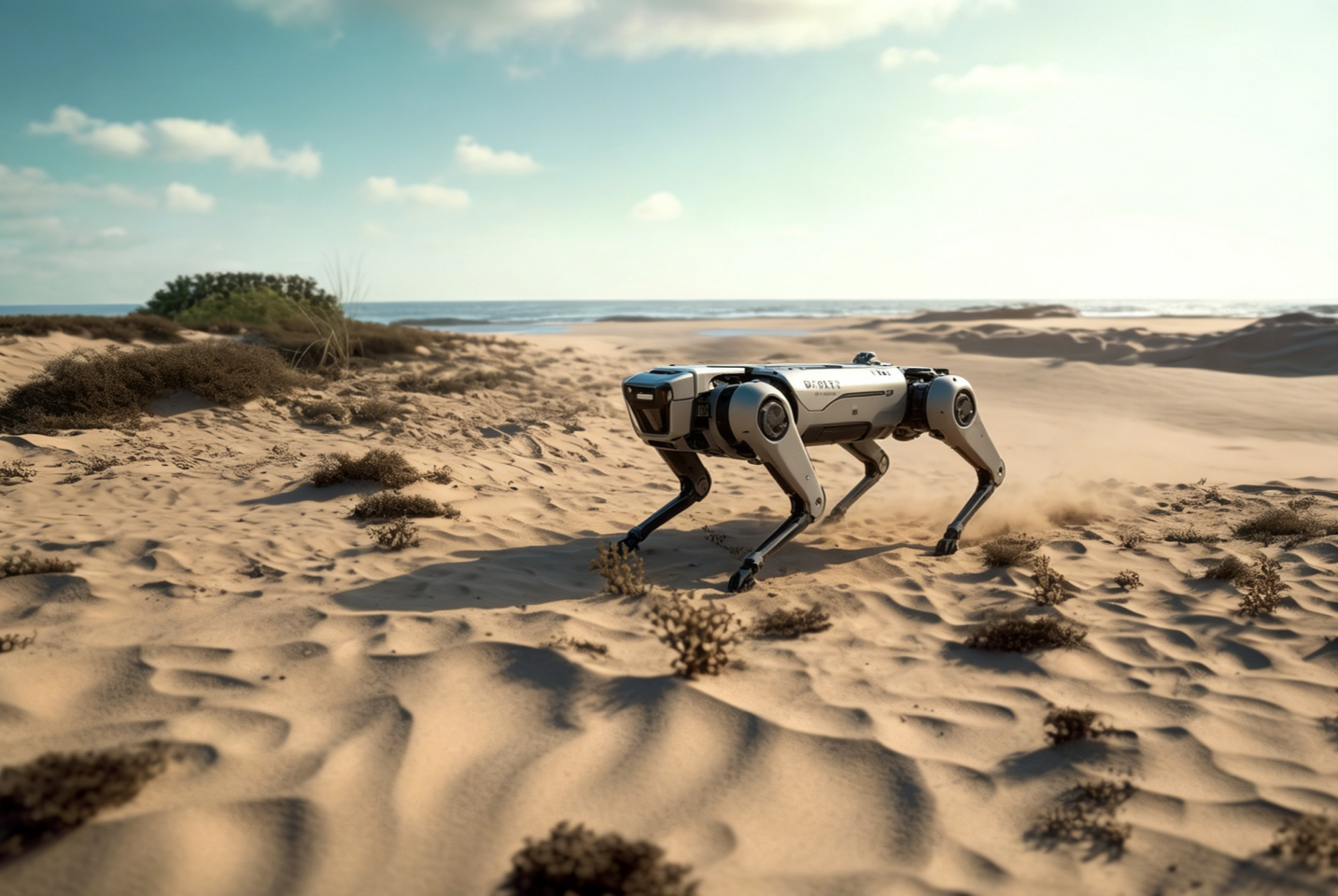
At the same time, China’s intelligent border-defense development is advancing at an unprecedented pace. In March this year, a silver-gray patrol robot was deployed on the Karakoram Plateau at an altitude of 5,300 meters along the China-India border. With autonomous cruising and 360-degree all-round monitoring, it was described by Indian media as a “sci-fi sentry.” This is a vivid example of China’s technology-enabled border protection moving from concept to real-world deployment. Designed for extreme border environments such as high altitude, severe cold, low oxygen, and complex terrain, the robot can operate stably at 5,300 meters above sea level, where oxygen levels are only about 60% of those on the plain, and can withstand temperatures ranging from -40°C to 55°C. At the Erenhot port in Inner Mongolia, an intelligent monitoring robot independently developed by the local border inspection station has entered duty, enabling a shift from manual train-following inspection to intelligent monitoring for international passenger trains. In Guangxi, an intelligent security patrol vehicle with L4 autonomous driving capability has entered trial operation in Dongxing, Fangcheng port, providing 24/7 autonomous patrol, precise recognition, and real-time warning. From northern to southern borders, from plateaus to ports, tireless “steel sentries” are now on duty around the clock.
Driven by both supportive policies and real operational needs, border patrol inspection robots are rapidly evolving from autonomous patrol to autonomous decision-making. With AI models trained on border incident cases, terrain features, and tactical patterns, robots are gradually gaining the ability to distinguish civilians, armed personnel, and livestock, while accurately identifying high-risk behaviors such as suspicious gatherings or equipment setup. This places extremely demanding requirements on the core controller: powerful AI computing for real-time deep learning inference, synchronized acquisition from multiple sensors, a rich set of industrial communication interfaces, and strong environmental adaptability. In practice, the controller must provide high AI performance, support multiple camera inputs for 360-degree panoramic perception, and offer vehicle-grade communication interfaces such as CAN FD and RS232/485 to connect with the chassis and sensor systems.
Case Background
Along long land borders, patrol operations face multiple challenges, including harsh environments, complex terrain, limited manpower, and high risk. Traditional manual patrols are not only inefficient; in extreme conditions such as high altitude, severe cold, and large temperature differences, the physical endurance and safety of personnel are also severely tested. With the rapid development of embodied intelligence, intelligent border patrol inspection robots integrating autonomous navigation, environmental perception, AI recognition, and real-time communication are becoming key equipment for replacing manual work on high-risk routes and enabling all-weather border monitoring.
A leading domestic provider of special-purpose robot solutions faced the following challenges while developing the core control system for its next-generation intelligent border patrol inspection robot:
Customer Challenge
1. High-performance AI inference: The border patrol inspection robot needs to process multiple HD video streams in real time and perform deep learning inference tasks such as personnel and vehicle recognition and abnormal behavior analysis. This requires strong AI computing performance while keeping power consumption within a reasonable range for a battery-powered mobile platform.
2. Synchronized multi-camera acquisition: The robot needs to integrate multiple HD cameras and infrared thermal cameras to achieve 360-degree all-round environmental perception. The controller must support multiple GMSL2 camera interfaces and GNSS time synchronization to ensure precise frame alignment across all image streams.
3. Support for vehicle communication protocols: Border patrol inspection robots are usually built on wheeled or tracked chassis platforms. Their motor drive systems communicate through the CAN bus, while sensors such as LiDAR, IMU, and GNSS/BeiDou also need to be connected. Therefore, the controller must natively support industrial communication interfaces such as CAN FD and RS232/485.
4. High-bandwidth real-time data transmission: HD video and sensor data collected during patrol operations must be transmitted back to the command center in real time. The controller therefore needs 10GbE or Gigabit network bandwidth to ensure low-latency and highly reliable data transmission.
5. Adaptability to extreme environments: Border patrol inspection robots must operate reliably under harsh conditions such as high altitude, severe cold, large temperature differences, and strong vibration. This sets very high requirements for wide-temperature operation, vibration resistance, and shock resistance.
6. Compact and lightweight design: Space inside the robot is highly limited. The controller must remain extremely compact while maintaining high performance, helping reduce the overall weight of the system.
APQ Solution
After multiple rounds of rigorous product selection and on-site environmental testing, the customer selected the APQ TER30J-C3 Embodied Intelligent Robot Controller as the core computing and communication platform for its intelligent border patrol inspection robot. The solution offers the following key advantages:
01 275 TOPS computing power for real-time AI inference:
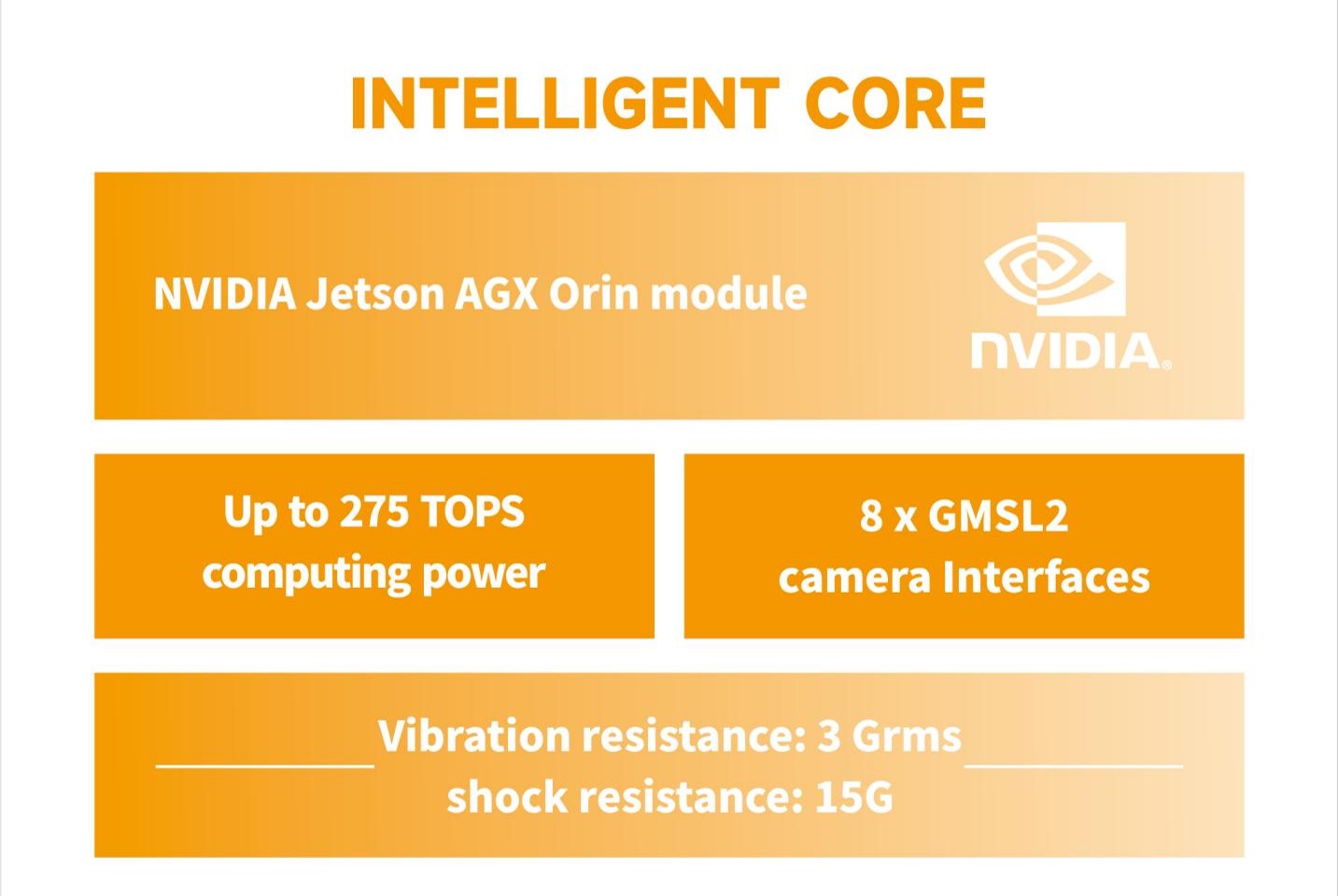
The TER30J-C3 is equipped with an NVIDIA Jetson AGX Orin series core module, delivering up to 275 TOPS of AI performance. It can run deep learning models such as object detection, behavior recognition, and semantic segmentation directly at the edge, enabling millisecond-level identification and warning for personnel, vehicles, and abnormal behavior. This provides strong computing support for autonomous decision-making in border patrol inspection robots.
02 8 GMSL2 camera interfaces for panoramic perception:
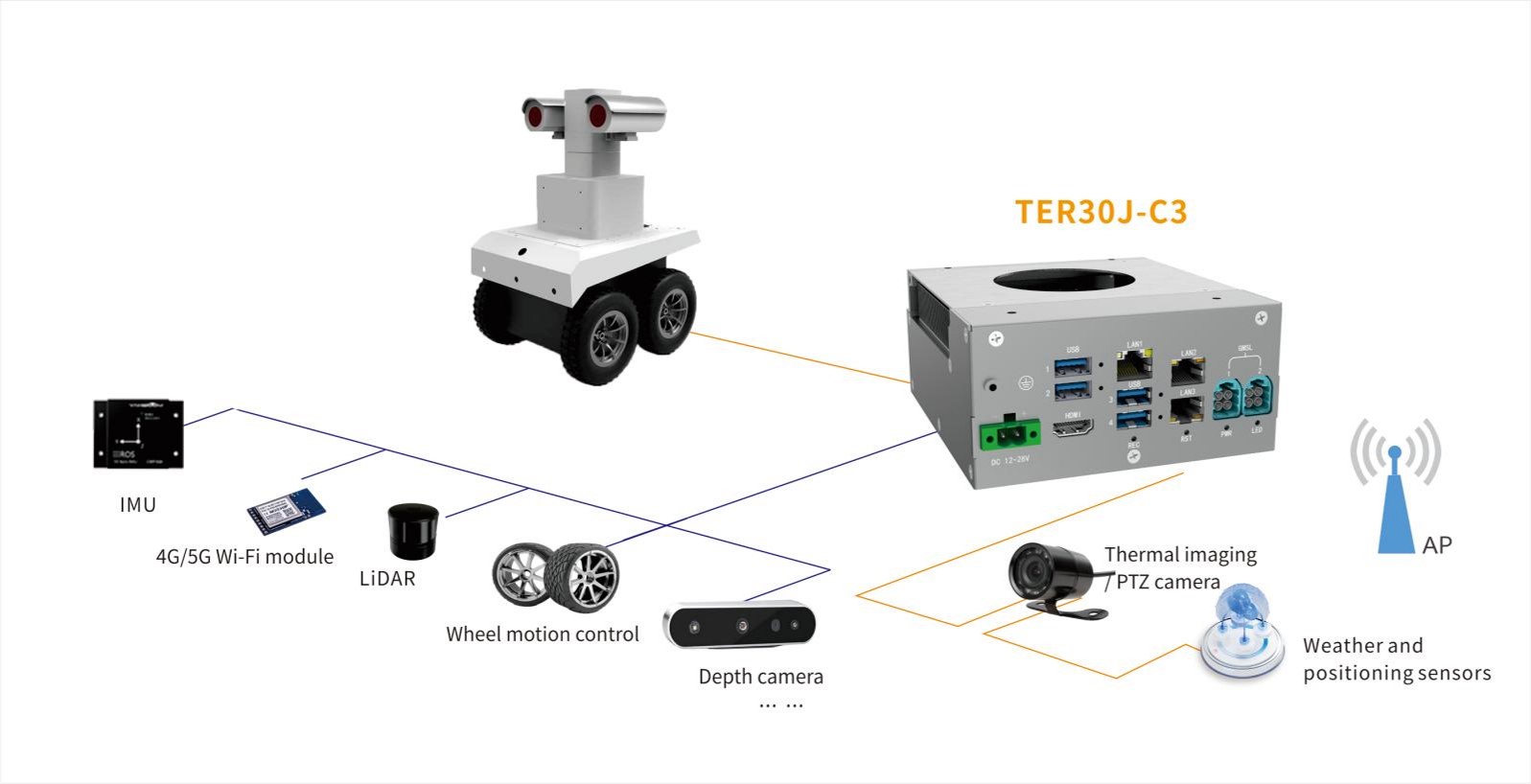
The TER30J-C3 comes standard with 8 GMSL2 camera interfaces and supports GNSS time synchronization. These interfaces can connect multiple HD visible-light cameras and infrared thermal cameras at the same time, enabling 360-degree all-round environmental perception. Precise synchronized acquisition of multi-channel image data provides high-quality data support for key functions such as SLAM-based autonomous navigation, target tracking, and abnormal-event alerts.
03 CAN FD plus multiple serial ports for chassis and sensor connectivity:
The TER30J-C3 natively supports 2*RS232/RS485 channels, 2*CAN FD channels, and 8*GPIO channels. The 2*CAN FD channels can directly connect to the patrol robot’s chassis motor drive system without an additional CAN expansion module. RS232/485 ports can connect sensors such as LiDAR, IMU, and encoders. The 8*GPIO channels can be flexibly configured as actuator interfaces for alarm output, lighting control, and other functions. This interface configuration fits the native multi-bus communication needs of wheeled and tracked mobile robots.
04 10GbE plus dual Gigabit Ethernet for efficient data aggregation:
The TER30J-C3 provides one 10GbE port and two independent Gigabit Ethernet ports. The 10GbE port enables fast extraction of large-model training data, providing abundant high-quality materials for continuous AI model optimization. The dual Gigabit ports can be used separately for LiDAR point-cloud data input and communication with the backend control center, allowing data streams to be separated and reducing network congestion.
05 Wireless expansion for mobile connectivity:
The TER30J-C3 supports M.2 Key-B expansion for 4G/5G modules and M.2 Key-E expansion for WiFi/BT modules. In scenarios where wired networks are difficult to deploy, 4G/5G communication ensures real-time connectivity between the robot and the command center, while WiFi/BT supports on-site debugging and short-range communication.
06 Ultra-compact chassis with wide-temperature and anti-vibration design for extreme environments:
The complete unit measures only 118.2mm x 130mm x 57.6mm, roughly palm-sized. Its all-aluminum alloy chassis and bracket-mount design allow it to be flexibly embedded into the limited internal space of a patrol robot. In terms of environmental adaptability, the TER30J-C3 supports an operating temperature of -20°C to 50°C and a storage temperature of -40°C to 80°C, and has passed 3Grms random vibration and 15G shock tests. It also supports 12-28V wide-range DC input, enabling direct compatibility with the 24V vehicle battery systems commonly used in border patrol inspection robots, eliminating the need for additional power conversion modules and simplifying the overall power supply design.
Value Achievements:
By adopting the APQ TER30J-C3 Embodied Intelligent Robot Controller, the border patrol inspection robot solution provider successfully achieved the following results:
Significantly improved AI inference efficiency: With 275 TOPS of computing power, deep learning models can run in real time at the edge. Response speed for object recognition and abnormal behavior analysis is several times higher than in traditional solutions, providing the computing foundation for robots to evolve from autonomous patrol to autonomous decision-making.
Highly integrated multi-source perception system: The combination of 8 GMSL2 camera interfaces, GNSS time synchronization, 2 CAN FD channels, and 2 RS232/485 channels enables one-controller access for HD cameras, infrared thermal cameras, chassis motors, LiDAR, IMU, and other devices. This greatly simplifies the system architecture and reduces overall BOM cost and integration complexity.
Sufficient bandwidth for data aggregation: The 10GbE plus dual Gigabit Ethernet architecture supports rapid extraction of large-model training data and accumulates high-quality materials for continuous AI algorithm optimization. It also enables smooth data stream separation, ensuring stable and reliable communication links over long-distance border scenarios.
Strong adaptability to harsh environments: The ultra-compact aluminum alloy chassis, wide-temperature operating design, IEC vibration and shock resistance, and 12-28V wide-voltage input allow the controller to operate stably in border patrol robots under long-term vibration, sharp temperature changes, and power supply fluctuations. This significantly reduces on-site failure rates and maintenance costs.
As the Ministry of Industry and Information Technology and the State-owned Assets Supervision and Administration Commission of the State Council jointly launch the real-world training initiative for embodied intelligence, and as intelligent border-defense development accelerates nationwide, China’s “smart border defense” is advancing faster than ever. From the “sci-fi sentry” on the Karakoram Plateau to the intelligent monitoring robot in Erenhot, from the L4 security patrol vehicle in Guangxi to the intensive rollout of border robot procurement projects across the country, this shift from manpower-based patrol to technology-enabled border control is creating demanding requirements for core controllers in computing power, sensor fusion, communication bandwidth, and environmental adaptability.
With up to 275 TOPS of AI computing performance, 8 GMSL2 camera interfaces, 10GbE plus dual Gigabit Ethernet networking, and comprehensive vehicle communication interfaces including CAN FD and RS232/485, the APQ TER30J-C3 Embodied Intelligent Robot Controller is an ideal fit for the core needs of border patrol inspection robots in extreme environments. It supports high-performance AI inference, synchronized multi-channel video acquisition, real-time data backhaul, and multi-bus device integration. Its ultra-compact size, wide-temperature operation, vibration resistance, and wide-voltage industrial design make it a reliable “intelligent brain” for wheeled and tracked mobile robots in border inspection, autonomous driving, and intelligent patrol applications.
Post time: Jun-29-2026


